
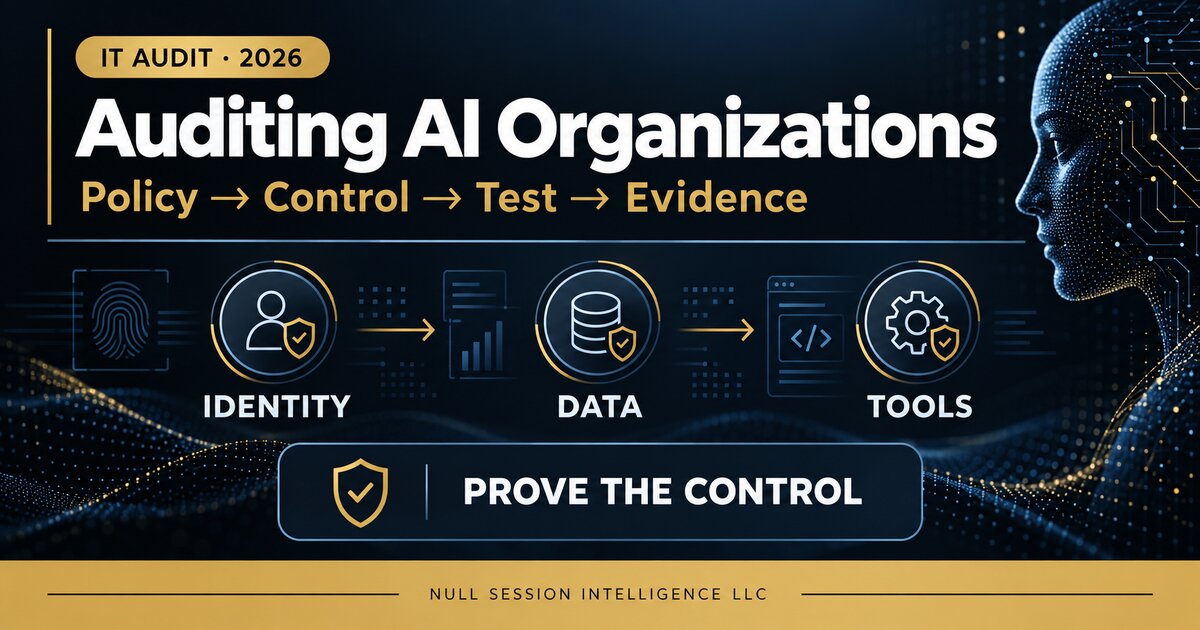
Most organizations can write an AI policy in an afternoon. The harder question is whether anyone can prove that it changes what systems, people, and vendors actually do.
The audit target is a system, not a document
AI-enabled work rarely lives in one application. A support assistant may call a model provider, retrieve internal documents, invoke a ticketing tool, and write to a CRM. A coding assistant may see source code, secrets in environment variables, and pull requests. “Protect confidential data” is directionally right, but it does not identify the flow or the control that stops it.
Start with use cases, not model names. Record purpose, users, data classes, provider, connected tools, environment, human decision point, retention, and owner. This turns an AI register into an auditable map of trust boundaries.
If a control cannot be tied to an identity, a data flow, a system event, and an owner, it is a promise—not yet evidence.
Turn policy language into testable assertions
“Only authorized employees may use the assistant” becomes: every request is bound to a corporate identity; group membership is checked server-side; denied requests are logged; and offboarding removes access within the defined window.
“Customer data is not used to train public models” becomes: the contract and tenant configuration prohibit it; the API route is approved; payloads are filtered; and support exports do not create an uncontrolled copy. Each assertion needs an owner, an artifact, and a failure condition.
Policy claim                  Evidence to request
---------------------------   ------------------------------------------
Least privilege               IAM export + denied-request sample
Approved providers            Contract, tenant setting, endpoint inventory
Human oversight               Decision log + escalation sample
Data minimization             Payload schema + redaction test
Incident response             Alert rule + tabletop record + owner
Build the evidence chain
Connect five layers: identity, authorization, data, execution, and accountability. A reviewer should be able to select one use case and explain one request without collecting an entire customer dataset.
- Identity: who initiated the action, from which tenant, device, or service account?
- Authorization: which role, policy, token scope, or approval allowed it?
- Data: which fields entered the model or retrieval layer? Were secrets removed?
- Execution: which model version, prompt, retrieval result, tool call, and configuration produced the output?
- Accountability: who reviewed the result, accepted the risk, and can stop the workflow?
Do not confuse a dashboard screenshot with evidence. Prefer access-controlled logs, configuration exports, signed change records, controlled test results, and a small set of redacted request/response samples. Evidence must prove the control without becoming a second data breach.
Test controls adversarially—but safely
With synthetic records and an authorized account, test a cross-tenant retrieval, an over-broad tool call, a canary secret in a prompt, an expired token, and an unapproved provider route. The objective is not to “break the AI”; it is to verify that boundaries fail closed and that failures become visible.
For agentic workflows, inspect tool permissions separately from model permissions. A model may draft an email while the tool must not send it without confirmation. Human approval should be a real state transition, not a button the same automation can click. Keep each test narrow, logged, and reversible.
Common governance failures
- Inventory theater: teams list models but omit prompts, plugins, shadow SaaS, and service accounts.
- Permission ambiguity: the UI checks a role while the backend trusts a client-supplied flag.
- Unverifiable vendor claims: “enterprise privacy” is accepted without testing retention, training, subprocessors, deletion, or breach terms.
- Logging without meaning: logs show a request happened but not what data, policy decision, model, or tool participated.
- Human-in-the-loop theater: a reviewer is named but lacks time, context, or authority to reject an unsafe output.
A practical audit sequence
- Map: select the highest-impact use cases and draw identities, data, models, tools, providers, and owners.
- Assert: rewrite every policy claim as a pass/fail statement with expected evidence.
- Sample: choose successful, denied, exceptional, and offboarded-user events.
- Challenge: run low-impact negative tests with synthetic data and preserve raw evidence.
- Report: separate design gaps, operating failures, vendor dependencies, and unknowns.
- Remediate: assign containment, technical fix, detection improvement, and retest date.
What leaders should decide now
Executives do not need to approve every prompt. They do need to decide which data classes may enter AI systems, which decisions require human authority, what vendors must prove, how quickly access is revoked, and what evidence reaches the risk committee.
The strongest operating model offers approved providers, reusable redaction, scoped tools, model/version records, standard logging, safe test data, and a clear exception process. Governance accelerates when the secure route is easier than improvisation.
What happens next
AI audits will move from annual policy review toward continuous control testing. Providers will expose more configuration and provenance data, while attackers will target seams between identity, retrieval, tools, and human approval. Organizations that can produce compact, trustworthy evidence will adopt AI with less friction.
The strategic test is simple: can your organization demonstrate what an AI system may do, what it actually did, and who can stop it? If not, invest in evidence infrastructure—not another policy.
Frequently asked questions
What is the first step in auditing an AI-enabled organization?
Inventory the highest-impact use cases and map identities, data, models, tools, providers, owners, and decision points.
What counts as verifiable AI governance evidence?
Access exports, configurations, controlled tests, redacted logs, contracts, incident artifacts, and accountable approvals supporting a specific claim.
Should auditors test prompt injection and tool abuse?
Yes, with written authorization and synthetic data. Test narrow failure cases and verify prevention and detection.
How often should AI controls be retested?
After material changes and on a risk-based cadence. High-impact workflows need continuous or frequent checks.