
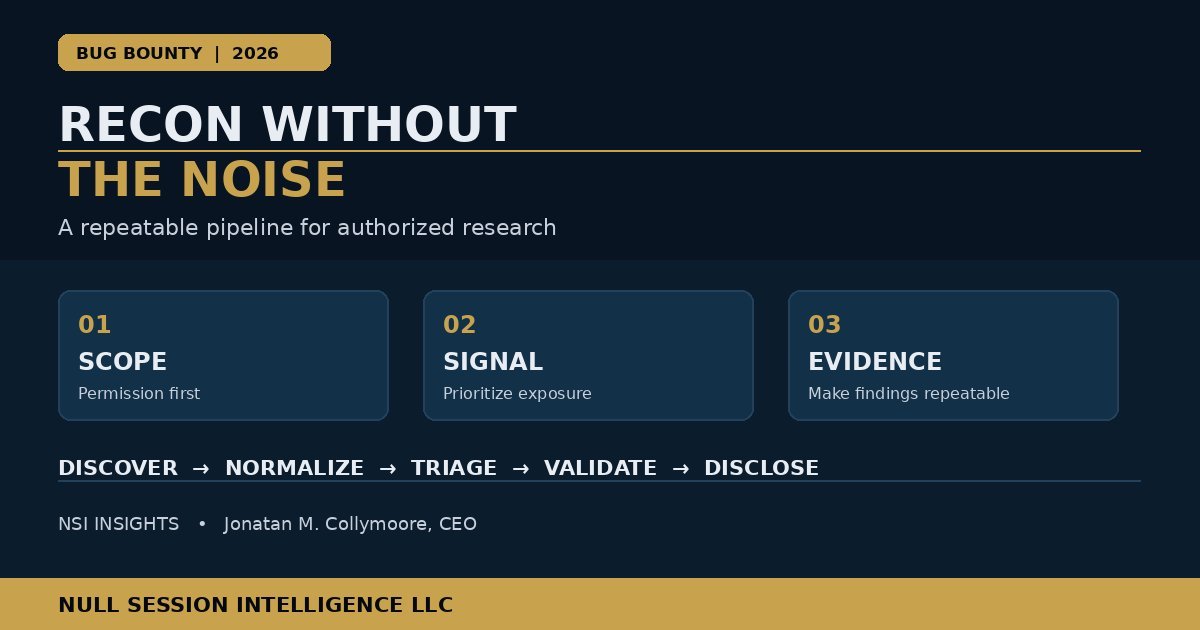
Bug bounty programs do not fail because researchers cannot find enough URLs. They fail when discovery produces more candidates than a human team can verify, explain, and disclose responsibly. The advantage is not a larger wordlist; it is a repeatable system that turns authorized observations into a small queue of credible hypotheses.
What is changing
Modern programs expose a moving collection of web apps, APIs, mobile backends, cloud assets, documentation sites, staging environments, and vendor integrations. Continuous delivery changes routes and certificates faster than a quarterly inventory can track. AI-assisted development also increases the volume of generated endpoints and configuration, but it does not establish ownership or permission.
For a program owner, this means “we have a bounty program” is not the same as “we know what researchers can safely test.” For a researcher, it means a long list of subdomains is not evidence of a valid target. Scope and confidence must travel with every asset.
Start with a scope contract
Before collecting data, capture the program policy, in-scope domains, excluded properties, rate limits, prohibited techniques, test-account rules, disclosure channel, and safe-harbor language. Preserve the policy URL and retrieval time. If the policy is ambiguous, ask through the official channel rather than interpreting silence as permission.
- Boundary: exact domains, applications, APIs, mobile packages, and environments.
- Identity: whether testing is anonymous, authenticated, or limited to supplied accounts.
- Impact: safe proof limits, synthetic data requirements, and an immediate stop condition.
- Evidence: what a valid report must include and how sensitive artifacts are handled.
A fast request sent to the wrong asset is not efficient research. It is an avoidable scope incident.
The pipeline: five controlled stages
1. Discover with provenance
Collect assets only from approved sources: program-provided lists, public DNS and certificate data within scope, owned documentation, and normal application workflows. Store the source, timestamp, resolver or tool context, and scope decision. A hostname without provenance is a lead, not a target.
2. Normalize and deduplicate
Canonicalize hostnames, schemes, default ports, paths, and parameter ordering. Keep redirects as relationships instead of deleting them; a redirect can reveal ownership or an environment transition. Cluster endpoints into route families such as /api/v1/accounts/{id}/exports instead of treating every identifier as a new discovery.
asset_key = normalize(host, scheme, port, path_template)
if asset_key not in inventory:
    inventory[asset_key] = {"sources": [], "status": "unreviewed"}
inventory[asset_key]["sources"].append(observation)
The goal is not to hide duplicates. Keep a count of observations and their sources so a reviewer can distinguish independent confirmation from repeated collection.
3. Classify signal
Prioritize candidates using transparent attributes: public exposure, authentication boundary, sensitive workflow, change recency, ownership confidence, and operational risk. This is triage, not vulnerability severity. A public export route deserves more attention than a static asset, even when both were discovered once.
| Signal | High-value example | Decision |
|---|---|---|
| Exposure | API, upload, reset, webhook | Move up the queue |
| Impact | Account recovery, billing, export | Use controlled test identities |
| Confidence | Unknown owner or stale asset | Confirm before probing deeply |
| Change | New route or deployment | Compare with prior snapshot |
4. Validate minimally
Use the least intrusive test that can answer the hypothesis. Confirm response behavior with synthetic records, avoid enumeration of real identifiers, and separate read-only discovery from state-changing requests. For authorization questions, use two controlled accounts with different roles and change one variable at a time. Stop when the response suggests real data exposure.
5. Package evidence
A report should let another researcher reproduce the observation without receiving unnecessary sensitive data. Record the in-scope asset, timestamp, request context, expected behavior, observed behavior, sanitized evidence, impact reasoning, and remediation hypothesis. Hashing a local evidence bundle can show that it was not altered while it moved through review.
Automation without autonomous scope expansion
Automation is valuable for collection, normalization, clustering, snapshot comparison, and queue management. It becomes dangerous when it guesses scope, increases concurrency because a target is slow, brute-forces identifiers, or treats an anomaly as a finding. A safe worker has an allowlist, rate limiter, read-only default, audit log, and kill switch.
for observation in approved_sources:
    if not policy.allows(observation.asset):
        continue
    candidate = normalize(observation)
    queue.upsert(candidate, provenance=observation.source)

for candidate in queue.high_confidence(limit=20):
    human_review(candidate)
    run_low_impact_check(candidate)
AI can summarize repeated responses, suggest route families, compare inventories, and flag contradictions between policy and observed behavior. Human researchers still decide whether a test is permitted, whether a behavior is exploitable, and whether the evidence supports disclosure.
Metrics that reward quality
Do not optimize for subdomain count. Track time from discovery to triage, duplicate rate, percentage of candidates with an owner and source, validation yield, false-positive rate, median evidence-completion time, and scope exceptions. For program owners, measure how quickly new assets are added to policy and how often researchers receive a clear answer.
A practical weekly runbook
- Monday: snapshot policy, scope, and known assets.
- Tuesday: collect approved observations and preserve provenance.
- Wednesday: normalize, deduplicate, and classify route families.
- Thursday: validate the highest-confidence, highest-impact hypotheses with synthetic data.
- Friday: reproduce, redact, and submit only evidence-backed findings.
What happens next
Bug bounty recon will become more automated and more crowded. The winners will not be the teams that produce the most candidates; they will be the teams that can show why each candidate was in scope, how it was prioritized, and what evidence supports the conclusion. AI will compress the clerical work, while governance and judgment become the differentiators.
Frequently asked questions
What makes a recon pipeline repeatable?
A defined scope, documented sources, deterministic normalization, deduplication, transparent triage, bounded validation, and evidence that another reviewer can reproduce.
Is every discovered subdomain in scope?
No. Discovery creates a candidate. The program policy, ownership confirmation, and safe-harbor terms determine whether testing is permitted.
How can AI help bug bounty recon safely?
AI can normalize data, cluster routes, compare snapshots, and summarize observations. It should not expand scope, send destructive requests, or declare a vulnerability without human validation.
What evidence belongs in a report?
Include the in-scope asset, timestamp, test context, expected and observed behavior, minimal sanitized proof, impact reasoning, and a clear remediation hypothesis.
Need an authorized bug bounty workflow?
NSI helps teams turn changing attack surfaces into bounded, evidence-backed security decisions.
Discuss your scope