
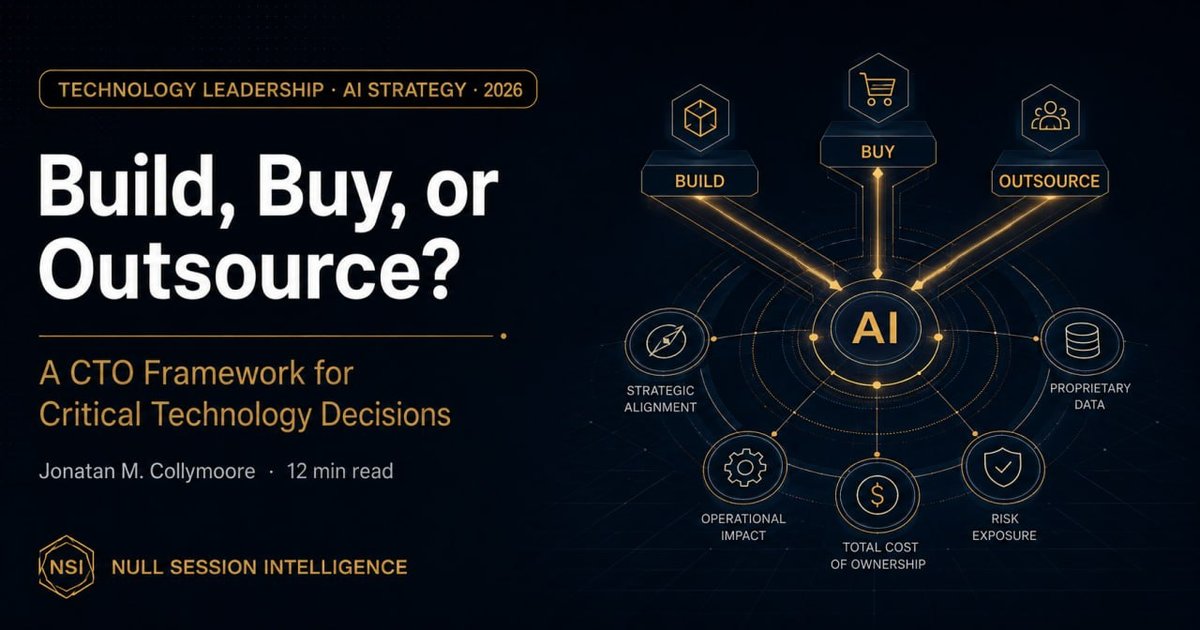
Every technology leader has faced the question in some form: should we build this ourselves, buy it from a vendor, or outsource it to a partner? For decades the answer came down to a familiar trade-off between cost, control, and speed. Then AI changed the terms of the debate. Models are now a commodity you can rent by the token. Capabilities that were impossible to build a few years ago are available as APIs. And the line between "product," "platform," and "service" has blurred to the point where the old mental models no longer hold.
The result is that build, buy, or outsource decisions are now the most consequential technology calls an organization makes—and they are being made with frameworks designed for a pre-AI world. This article proposes a practical framework: a structured way to evaluate any critical technology decision across five dimensions—strategic leverage, data advantage, operational readiness, cost model, and risk—and route it to build, buy, or outsource with confidence.
Why the old framework broke
The classic build-versus-buy heuristic was simple: build if it is core to your business, buy if it is a commodity, outsource if it is not core and you lack the team. That heuristic survived because most technology was slow to change, expensive to build, and stable once deployed. AI has broken all three assumptions.
First, the build cost curve has changed shape. Training frontier models is out of reach for most organizations, but fine-tuning an open-weight model, wiring a retrieval pipeline, and building a product on top of APIs is dramatically cheaper than building traditional software from scratch. The economics of "building" now range from a weekend experiment to a hundred-million-dollar training run, which means the word itself has lost predictive power.
Second, the value has moved from the model to the system. A raw model is a commodity. The differentiation lives in data, evaluation, orchestration, integration, and the workflows that wrap the model. This means the strategic question is no longer "can we build the model?" but "what surrounds the model—and who owns it?"
Third, the market moves monthly. Vendors release new capabilities on a cadence that internal teams cannot match without enormous focus. A capability you could justify building in January may be a default feature of an existing product by June. The cost of being wrong about the trajectory has gone up, and the cost of deferring the decision has gone down—which paradoxically makes structured, repeatable decision-making more valuable, not less.
The question is no longer "can we build it?"—almost anyone can build a prototype. The question is whether you can operate it at production quality, for years, better than the market can supply it.
The five dimensions of the decision
Every critical technology decision should be evaluated against the same five dimensions. Score each one honestly, with evidence, and the right answer usually emerges—not from a formula, but from a structured conversation that forces the right questions to be asked.
1. Strategic leverage: how much does this capability differentiate you?
If the capability is invisible to your customers, generic across your industry, or table stakes to operate, it is a candidate for buying or outsourcing. If it is the reason customers choose you—the thing your competitors cannot easily copy—it deserves serious consideration for building. Strategic leverage is not binary: score it as core, differentiating, or table-stakes. Only "core" justifies a build by itself.
2. Data advantage: do you own data that makes the capability better?
This is the strongest signal in the AI era. Models improve with data, and the data that matters is specific: your domain, your customers, your workflows, your feedback loops. If your organization possesses proprietary data that a vendor cannot access—and that data materially improves the outcome—you have a defensible reason to build. If your data is generic, or the vendor already has better data than you, the advantage evaporates.
Be honest about this. Many organizations believe they have proprietary data when what they actually have is a copy of data anyone could license. The test: would the vendor's product improve materially if they had your data? If yes, and you keep that data exclusive, build becomes defensible. If no, the data is not the moat you think it is.
3. Operational readiness: can you run this in production for years?
Building is the easy part; operating is the commitment. Production AI systems require MLOps discipline, monitoring, evaluation pipelines, incident response, security review, compliance work, and a team that stays current as the underlying technology shifts. If your organization has no track record of operating ML workloads, no dedicated ownership, and no executive sponsorship that survives the next reorg, the build path is a bet against your own organization's history.
4. Cost model: what does each path actually cost over three to five years?
Build costs are dominated by people and maintenance, with inference and infrastructure growing as usage scales. Buy costs are subscription fees plus integration effort, with unit economics set by the vendor. Outsource costs are contract fees plus your own specification and governance time. Model all three honestly, including the opportunity cost of your team's attention. The cheapest path at year one is rarely the cheapest at year five.
5. Risk: what breaks, and who absorbs it?
Risk has three faces here: execution risk (will we deliver?), vendor risk (will the vendor exist, stay fair, and keep the product healthy?), and security/compliance risk (who owns the data, the access, and the liability?). Buying transfers execution risk to the vendor but concentrates vendor and platform risk. Building concentrates execution risk but maximizes control. Outsourcing splits execution risk with a partner while leaving specification and accountability with you. Score the risk profile you can actually tolerate—and remember that in regulated industries, the accountability for a failure rarely transfers with the contract.
The routing table
Once the five dimensions are scored, route the decision with this table. It is a starting point, not an oracle—but it reliably identifies the cases where teams talk themselves into the wrong answer.
| Profile | Route | Why |
|---|---|---|
| Core differentiation + real data advantage + proven operations team | Build | You can create durable advantage the market will not replicate; control of data and roadmap compounds over time. |
| Core differentiation but no data advantage or weak operations | Build selectively / buy the base | Build the thin layer that differentiates you; rent the model, infrastructure, or platform underneath. |
| Table-stakes capability, mature market, no data advantage | Buy | The vendor's scale, roadmap, and unit economics beat anything you can assemble internally. |
| Needed capability, no internal team, time-bound delivery | Outsource | You need execution now without building organizational muscle you do not want to retain. |
| Experimental / uncertain trajectory, low stakes | Prototype internally, then re-evaluate | Cheap exploration resolves the biggest unknowns before committing to a path. |
Special cases in the AI era
Three situations deserve their own treatment because they do not fit the classic framework cleanly.
The hybrid: buy the base, build the edge
The most common winning pattern in 2026 is neither pure build nor pure buy—it is a deliberate split. Rent the commodity layers (foundation models, vector infrastructure, identity, payments) and build the layers where your data and workflows create advantage (prompt and evaluation systems, domain workflows, integration with your product). This maximizes speed and minimizes the surface area you must operate, while preserving the differentiation that matters. The discipline is deciding where the line falls—and refusing to drift it toward build when a vendor capability appears.
Outsourcing AI is not outsourcing software
Traditional outsourcing assumed stable, specifiable requirements. AI work is different: outcomes are probabilistic, quality is evaluated rather than tested, and requirements evolve as you learn what the model can do. If you outsource AI, budget for a substantially longer specification and evaluation phase, insist on access to the evaluation data and tooling, and treat the partner as a capability builder rather than a capacity provider. The organizations that succeed with AI outsourcing are the ones that invest in their own ability to specify, evaluate, and accept AI output—which means you will need some internal expertise even when you outsource.
The rebuild decision
Legacy systems are where many AI-era decisions actually live. A system built five years ago may now be replaceable by a vendor product that includes the AI capability as a default feature—or may be holding data that makes a build newly attractive. Run legacy systems through the same five dimensions. The bias should be toward buying or modernizing rather than rebuilding from scratch, unless the data advantage case is strong: rebuilding a system to preserve a data moat is defensible; rebuilding it to preserve a codebase is usually nostalgia.
A practical action framework
Turning the framework into a decision takes a week of structured work, not a year of analysis. Here is the sequence that works in practice.
- Define the capability boundary. Write down exactly what outcome you need, not the technology you assume it requires. Most build-versus-buy debates are really debates about an ill-defined problem.
- Score the five dimensions with evidence. For each dimension, require at least one concrete data point: a customer signal for leverage, a data inventory for advantage, a hiring plan for readiness, a three-year cost model for economics, and a named risk owner for risk.
- Run the routing table. Identify your profile and the default route. If the default feels wrong, the issue is usually a miscalibrated dimension—go back and challenge the evidence.
- Build a 90-day proof point for the leading candidate. For buy, run a pilot with the vendor. For build, ship a production-quality prototype with the actual team that would own it. For outsource, run a small scoped engagement. Let the proof point falsify the framework if it can.
- Write the decision down, including the revisit date. Record the scores, the evidence, and the conditions under which you would revisit. The AI market moves monthly; a decision that is right in August deserves a scheduled re-check, not a permanent verdict.
What leaders should watch next
Three trends will keep reshaping this framework over the next two years.
First, the commodity layer is expanding upward. Agentic platforms, evaluation services, and vertical AI products are absorbing capabilities that were build-candidates a year ago. The line between "buy the base" and "build the edge" keeps moving—and leaders who re-run the framework quarterly will catch the shifts while leaders who treat decisions as permanent will carry technical debt they no longer need.
Second, data advantage will become the explicit criterion. As models commoditize, the only durable moat is data that is exclusive, high-signal, and continuously refreshed. Organizations will increasingly be evaluated on their data flywheels the way they are evaluated on their balance sheets—and the build-versus-buy answer will increasingly be decided by who holds the data, not who holds the code.
Third, outsourcing will professionalize around evaluation. The firms that win will be those that can specify, test, and accept probabilistic systems—which means both clients and partners will invest in evaluation infrastructure as a first-class discipline. The organizations that treat AI outsourcing as a staffing transaction will be disappointed; the ones that treat it as a capability-building partnership will compound.
The build, buy, or outsource decision was never really about technology. It is about what your organization is genuinely good at, what it is willing to maintain, and what it must own to win. The AI era has not changed that—it has just made the question more expensive to get wrong. A structured framework, honestly applied, is the cheapest insurance you can buy against the most expensive mistake a CTO can make.
Official references
- Martin Fowler — Lean Inception — structuring product discovery before committing to build or buy.
- Andreessen Horowitz — AI and the cost of building software — how AI changes the economics of software production.
- Total Cost of Ownership (TCO) — Search Engine Land — a practical definition and calculation approach.
- Outsourcing — Wikipedia — the classic definition of outsourcing and its risk structure.
- NIST AI Resources — the AI Risk Management Framework for evaluating AI-related risk in technology decisions.
Frequently asked questions
When should a company build instead of buy AI capabilities?
Build when the capability is a strategic differentiator that depends on proprietary data, when the market cannot supply the specific behavior you need, or when ownership of the model, pipeline, and infrastructure creates durable advantage. If a mature product already solves the problem at acceptable cost and your team cannot realistically operate a production ML pipeline, buying is usually the better economic and risk decision.
What is the difference between buying and outsourcing in technology decisions?
Buying means adopting a commercial or open-source product operated by the vendor or maintained as a dependency. Outsourcing means commissioning a third party to build or operate a capability on your behalf—custom software, managed services, or staff augmentation. Buying transfers most operational risk to the vendor; outsourcing transfers execution but not the specification, integration, or accountability, which remain yours.
How do you calculate total cost of ownership for a build decision?
Model at least three to five years: engineering salaries with overhead and recruiting, infrastructure and model-inference costs, data acquisition and labeling, security and compliance work, incident response, and the cost of the team's time diverted from other priorities. Add a maintenance multiplier—production systems typically cost 15 to 30 percent of initial build cost annually—and compare against subscription fees plus integration effort for the buy path.
What role does organizational readiness play in build versus buy decisions?
It is often the deciding factor. A team that has never operated production ML, lacks an MLOps practice, or cannot retain specialized talent will struggle to make a build succeed regardless of the economic model. Build decisions are really organizational decisions: they require sustained executive sponsorship, clear ownership, and the discipline to maintain a roadmap for years, not quarters. If those conditions are absent, buying or outsourcing is the lower-risk path.
Making a critical technology decision?
Null Session Intelligence helps technology leaders evaluate build, buy, and outsource decisions with structured frameworks, technical due diligence, and independent risk assessment.
Discuss your decision