Designing Disaster Recovery for Virtualized and Cloud Workloads: RPO, RTO, Testing, and Failover

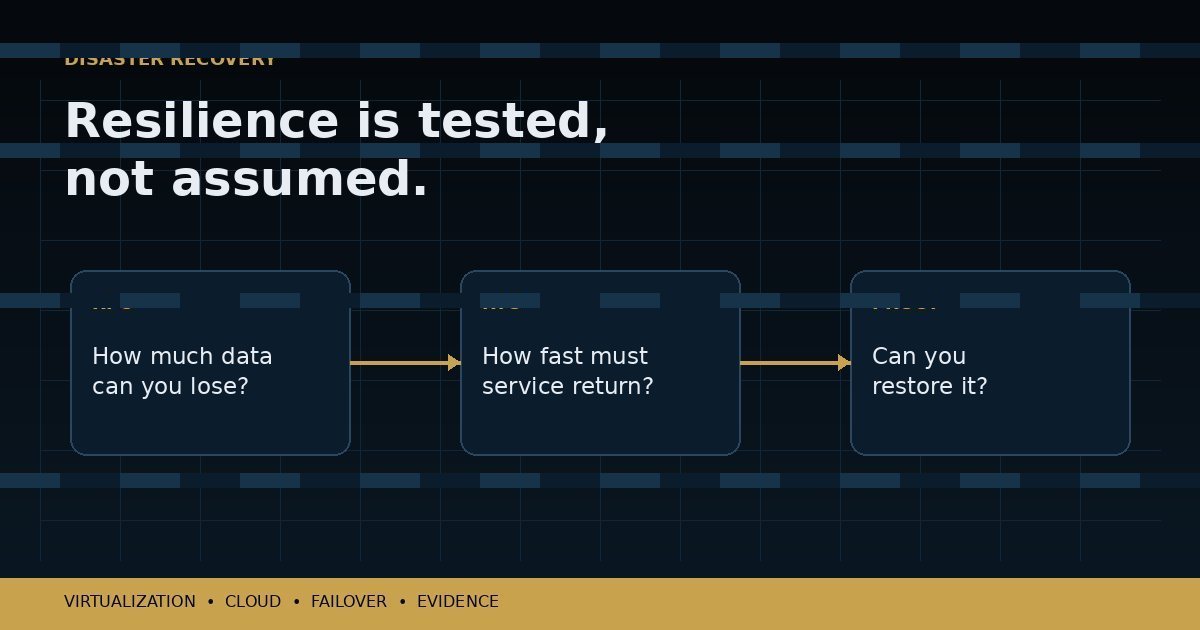
The recovery plan is an operating model
Virtualization and cloud make it easier to copy workloads, move them between failure domains, and automate infrastructure. They also hide dependencies: identity, DNS, secrets, licensing, queues, object storage, certificates, APIs, and control planes may all matter when the primary environment is impaired.
Disaster recovery is not a second copy of a virtual machine. It is a tested method for restoring a business capability when the primary environment, provider, network, or administrative boundary is affected.
Recovery objectives are business decisions translated into technical constraints—and verified with evidence.
RPO and RTO: two different promises
Recovery Point Objective (RPO) answers how much data the business can lose. Recovery Time Objective (RTO) answers how long the service can be unavailable. Map both to revenue, safety, contracts, customer commitments, and manual workarounds—not to ambitious-sounding numbers.
service: customer-api
rpo: 15m
rto: 60m
replication: asynchronous-cross-zone
restore_order: identity -> database -> queue -> api -> observability
proof: measured-restore + synthetic-transaction
Map dependencies before buying resilience
For each workload, record data stores, identity providers, secrets, network routes, certificates, external APIs, queues, DNS records, operators, recovery credentials, and the failure domain of each component.
- Data: frequency, retention, immutability, encryption, and restore granularity.
- Compute: images, templates, versions, quotas, capacity, and licensing.
- Identity: break-glass accounts, MFA recovery, roles, federation, and audit logs.
- Operations: runbooks, contacts, monitoring, DNS, certificates, and change records.
Replication is not recovery
Replication can reduce data loss, but it can also replicate corruption, deletion, or an application mistake. Keep an independent backup path with appropriate retention and immutability. Test point-in-time recovery and confirm that operators can access the recovery environment without relying on a failed identity or network dependency.
Design failover as a controlled sequence
Define declaration, evidence preservation, recovery-point confirmation, access, identity and secrets, data, dependency order, synthetic transactions, traffic redirection, observation, communications, and rollback. Make clear what is automatic and what requires human approval. High-impact actions should be observable, reversible where possible, and protected by separate credentials.
Testing: from tabletop to measured recovery
- Tabletop: walk through assumptions, contacts, authority, and communications.
- Component restore: restore a database, image, secret, or configuration in isolation.
- Service recovery: start the dependency chain and run synthetic transactions.
- Controlled failover: redirect an approved test path or workload in a defined window.
- After-action review: record measured RPO/RTO, surprises, evidence, owners, and due dates.
Do not report “the test passed” without measurements. State what restored, when the clock started, which customer-visible function worked, what data point was recovered, and what remained manual.
A 30-day action framework
- Week 1 — prioritize: classify services by business impact and assign RPO/RTO owners.
- Week 2 — map: document dependencies, recovery access, replication, and single points of failure.
- Week 3 — exercise: restore a representative workload with synthetic or approved data and capture timestamps.
- Week 4 — close gaps: fund the highest-risk failures, update runbooks, and schedule the next test.
What leaders should decide
Ask whether the design reduces interruption, whether the provider boundary is understood, whether recovery access works during an identity incident, and whether the organization can afford to test. Resilience spending is defensible when tied to a service tier, measured objective, and known failure mode—not a vague promise of high availability.
What happens next
Distributed workloads will need machine-readable dependencies, policy-controlled runbooks, and stronger evidence capture. AI can summarize telemetry or propose steps, but the authority to restore, redirect, delete, or declare a system healthy must remain governed. The winning architecture is the one the team can recover under pressure.
Frequently asked questions
What is the difference between RPO and RTO?
RPO measures acceptable data loss in time; RTO measures acceptable service interruption. They drive different technical and budget decisions.
Is cloud backup the same as disaster recovery?
No. Backup preserves copies; disaster recovery proves dependencies, access, configuration, networking, and application behavior can be restored.
How often should failover be tested?
The cadence should match change and impact. Critical workloads need regular exercised recovery and tests after major changes.
What evidence makes a recovery plan credible?
Timestamped results, restored application checks, measured RPO/RTO, dependency validation, identified failures, and tracked remediation.
Sources and further reading
- NIST SP 800-34 — contingency planning guidance.
- CISA StopRansomware — resilience and recovery practices.
- Google SRE: Embracing Risk — reliability objectives and trade-offs.