
Every production AI agent is, at its core, a networked system. The agent sends prompts to an LLM, queries a vector database, calls external APIs, and returns results to a user — each step crossing a network boundary. Yet networking is the most underestimated layer in agent infrastructure. Teams spend weeks perfecting agent prompts and tool definitions, then deploy them on default VPC configurations with standard load balancer timeouts and no segmentation, wondering why agents hang, time out, or leak data.
Network architecture for AI agents is distinct from traditional web application networking. Agents maintain long-lived sessions, generate bursty and unpredictable traffic patterns, communicate with dozens of external endpoints, and handle data at variable sensitivity levels — all within a single workflow. The network must support reliability, performance, security, and observability simultaneously, and the default configurations designed for stateless HTTP services will fail at every dimension.
This guide covers the network architecture patterns that production agent deployments require: segmentation models for safety and compliance, latency optimization for inference traffic, egress management for multi-API agents, service mesh integration for multi-agent communication, and the operational runbooks for keeping agent networks healthy at scale.
Why Agent Networking Is Different
Before diving into architecture, it is essential to understand how AI agent traffic differs from the workloads that traditional network designs were built to support.
Session persistence requirements. A web server can lose a connection, and the client retries with no lasting consequence. An agent that loses its connection to an LLM mid-inference loses the entire reasoning context. The agent must restart the task from scratch, wasting tokens and time. Agent network connections must be resilient — not just available at connect time, but stable for the duration of potentially long sessions that can last minutes or hours.
Bursty, multi-destination traffic. An agent's network traffic does not follow the steady request-response pattern of an API server. An agent may be silent for 30 seconds while reasoning internally, then issue five concurrent API calls — two LLM inferences, a vector search, a web fetch, and a database query — all within two seconds. The network must handle these bursts without queueing delays or packet drops, and must do so for hundreds of concurrent agents.
Variable data sensitivity. During a single session, an agent may process public data, internal proprietary information, and customer PII (personally identifiable information). The network must enforce data classification boundaries in real time — preventing PII from reaching an unapproved external API while allowing the same agent to access a public web resource. This is not a problem that traditional IP-based segmentation solves.
Egress asymmetry. Web applications are predominantly ingress-heavy — clients connect to servers. Agents are egress-heavy — they connect out to LLM APIs, vector databases, and tool endpoints. The egress bandwidth can exceed ingress by 10:1. Networks designed for ingress-heavy traffic (with thin uplinks and NAT gateways sized for client traffic) will bottleneck under agent workloads.
The network is the operating system of the agent deployment. Every failure mode — timeout, data leak, cost spike, session drop — first manifests as a network problem before it is visible anywhere else.
Network Segmentation for Agent Deployments
The Three-Zone Model
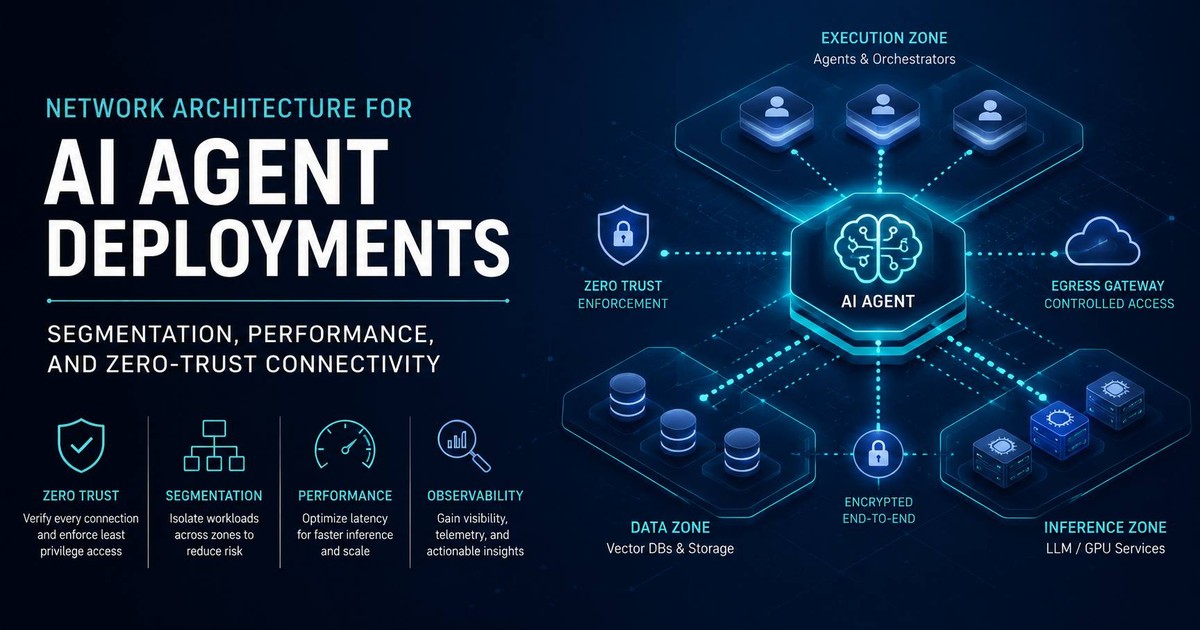
Production agent deployments benefit from a three-zone network segmentation model that separates compute, inference, and data planes:
- Agent Execution Zone — Where agent runtimes, orchestrators, and message brokers live. This zone has controlled egress to the inference zone and to approved external APIs, but no direct ingress from the internet. Agents in this zone initiate all connections.
- Inference Zone — GPU nodes running model serving infrastructure (vLLM, TGI, Ollama). This zone has no direct internet access and only accepts inbound connections from the agent execution zone. Inference servers connect to internal artifact registries for model downloads but do not reach external networks.
- Data Zone — Vector databases, relational databases, knowledge stores, and conversation logs. This zone has no direct internet egress and primarily responds to queries from the agent zone. Outbound traffic is allowed only for explicit internal dependencies such as same-zone database peers, DNS, backup or replication endpoints, and management services; each destination should be named in policy instead of allowing broad subnet egress.
This three-zone model enforces the principle of least privilege at the network level. An agent compromised through a prompt injection attack cannot reach the inference zone's API keys, cannot exfiltrate data from the vector database directly, and can only communicate with approved external services through a scrutinized egress gateway.
Kubernetes NetworkPolicies for Agent Micro-Segmentation
Within each zone, Kubernetes NetworkPolicies provide pod-level segmentation. A sample policy for isolating agent pods:
apiVersion: networking.k8s.io/v1
kind: NetworkPolicy
metadata:
  name: agent-isolation
spec:
  podSelector:
    matchLabels:
      app.kubernetes.io/component: agent-runtime
  policyTypes:
  - Ingress
  - Egress
  ingress:
  - from:
    - namespaceSelector:
        matchLabels:
          kubernetes.io/metadata.name: agent-orchestrator
    ports:
    - protocol: TCP
      port: 8080
  egress:
  - to:
    - namespaceSelector:
        matchLabels:
          kubernetes.io/metadata.name: agent-inference
    ports:
    - protocol: TCP
      port: 8000
  - to:
    - namespaceSelector:
        matchLabels:
          kubernetes.io/metadata.name: agent-data
    ports:
    - protocol: TCP
      port: 6333
    - protocol: TCP
      port: 5432
  - to:
    - namespaceSelector:
        matchLabels:
          kubernetes.io/metadata.name: agent-egress
      podSelector:
        matchLabels:
          app.kubernetes.io/name: egress-proxy
    ports:
    - protocol: TCP
      port: 3128
  - to:
    - namespaceSelector:
        matchLabels:
          kubernetes.io/metadata.name: kube-system
      podSelector:
        matchLabels:
          k8s-app: kube-dns
    ports:
    - protocol: UDP
      port: 53
    - protocol: TCP
      port: 53
The critical detail: agent pods have no general egress access. A broad private-range ipBlock does not force proxy use; it simply allows those destination IPs. Kubernetes NetworkPolicy egress rules are L3/L4 allow rules, so the policy should allow only required internal services, the egress proxy pods, and DNS. Domain allow-listing and data loss prevention (DLP) inspection then happen in the proxy, CNI extension, or service mesh layer before traffic reaches the internet.
Service Mesh for Agent-to-Agent Communication
In multi-agent architectures, agents communicate with each other, with orchestrators, and with evaluation systems. A service mesh or identity-aware dataplane can provide cryptographic workload identity and traffic management, but implementations differ: Istio and Linkerd commonly use sidecars or mesh dataplanes, while Cilium uses an eBPF datapath and Envoy for configured L7 functions rather than a per-pod sidecar model.
- mTLS between all agent services — Every selected agent workload gets a cryptographic identity. Communication is authenticated and encrypted according to the mesh or dataplane configuration, with no application-level certificate handling.
- Traffic splitting for agent versioning — Canary-deploy new agent versions by routing 5% of agent-to-agent calls to the new version while keeping 95% on stable.
- Circuit breaking for cascading failures — If the evaluation agent is slow, the configured sidecar, dataplane enforcement point, gateway, or application proxy fails fast rather than allowing unbounded queues and memory pressure.
- Access control at the mesh layer — Policies such as "only the orchestrator can call the evaluation agent" are enforced at the sidecar or dataplane enforcement point, depending on the mesh. Cilium enforces through its eBPF datapath and integrated/per-node Envoy where configured, not through a per-pod sidecar.
Latency Optimization for Inference Networking
The Three Phases of Inference Latency
LLM inference networking has three distinct phases, each with different sensitivity to network conditions:
Phase 1: Time-to-First-Token (TTFT). The prompt must be transmitted from the agent to the inference server before generation can begin, but prompt upload must be calculated in bytes on the wire, not model tokens per millisecond. If proxy logs show a 64 KB serialized request body, line-rate serialization on a 40 Gbps link is roughly 13 microseconds before RTT, congestion, TLS framing, queueing, tokenization, model prefill, and scheduler delay. Network distance still matters because every RTT, handshake, and retransmission adds to user-visible TTFT, but a text prompt measured in kilobytes should not be modeled as seconds of link transmission time.
Phase 2: Inter-Token Latency (ITL). Once generation starts, tokens stream back incrementally. Model execution usually dominates ITL, while network jitter, packet loss, or proxy buffering can create visible pauses in the output stream. Measure this as stream gap distribution at the client and at the egress or ingress proxy, not only as model-server token timing.
Phase 3: Total Response Delivery. After the last token, the complete response must be delivered to the agent's upstream consumer. This phase involves the least data (typically just the completion) and is rarely network-bound.
Placement Strategies for Inference Endpoints
For self-hosted inference, placing GPU servers close to agent runtimes reduces avoidable RTT, cross-zone transit, and shared-fabric contention. Treat the topology below as an ordering of network preference, then validate it with load tests for your model server, batch size, context length, and streaming behavior:
- Same rack, same ToR switch — Lowest network distance and least cross-rack contention. Practical when the GPU footprint fits within a rack-level failure domain.
- Same cluster, different racks — Acceptable for many workloads if GPU-rack uplinks are engineered separately from general cluster traffic and storage replication.
- Same region, different AZs — Useful for fault isolation, but it adds inter-zone latency and cloud data-transfer cost. Use only when availability requirements justify the tradeoff.
For API-based inference, the strategy is different since you cannot control the inference server's location. The key levers are:
- Documented provider endpoints — For direct public APIs, use the provider-documented endpoints such as
https://api.openai.com/v1/...shown in OpenAI's API reference andhttps://api.anthropic.comin Anthropic's documented API base. Do not invent regional hostnames unless the provider documents them for that product. If regional placement or data residency is required, use supported regional offerings such as Azure OpenAI resource endpoints, Amazon Bedrock regional runtime endpoints, or Google Cloud/Vertex AI locations. - HTTP/2 multiplexing — A single TCP connection handles multiple concurrent inference requests, eliminating connection establishment overhead for each call. Essential for agents that make parallel inference calls.
- Keepalive tuning — Set API connection idle timeouts above the measured gap between inference calls in your workload. Agent traffic often alternates between quiet reasoning periods and bursts of API calls, so short proxy or client keepalives can cause unnecessary TLS and TCP churn.
Bandwidth Planning for Inference Traffic
Inference bandwidth must be sized from serialized request and response bytes, not from model parameter count. A 70B-parameter model affects server memory and compute; the model weights do not cross the network on every API call. For a text-only API call, calculate:
per-call wire bytes = request body bytes + response body bytes + HTTP/TLS framing + headers
hourly bytes = agent count × calls per task × tasks per hour × p95 wire bytes per call
If your proxy telemetry shows a p95 wire payload of 64 KB per inference call, then 100 agents × 3 calls × 10 tasks × 64 KB = 192,000 KB/hour, or roughly 0.43 Mbps sustained before burst headroom. The same workload can become orders of magnitude larger when agents attach documents, images, tool outputs, retrieval context, or verbose logs, so capacity planning should use observed p95/p99 bytes per endpoint and separate burst capacity from sustained throughput.
For GPU clusters, dedicate inference network capacity only when measurement shows contention with storage, checkpoint loading, log shipping, or management traffic. The right NIC count and speed depend on model server placement, tensor or pipeline parallelism, streaming volume, and concurrent sessions; avoid hard-coding a per-GPU NIC rule without a benchmark from your own fabric.
Egress Architecture for Multi-API Agents
Allow-List Egress Proxies
The most critical network security control for AI agents is the egress proxy. Without it, every agent has unrestricted outbound internet access — a prompt injection vulnerability becomes a data exfiltration highway.
The egress proxy sits between the agent execution zone and the internet, applying three layers of filtering:
- Domain allow-listing — Only pre-approved domains are reachable. The allow list includes LLM API endpoints, vector database SaaS endpoints, approved tool APIs, and internal artifact registries. Everything else is denied by default.
- Content inspection — HTTP body inspection for sensitive data patterns (PII, API keys, credentials). If an agent attempts to send sensitive data to an external endpoint, the proxy blocks the request and alerts the operations team.
- Bandwidth throttling per endpoint — Rate limit egress to each API provider based on the agent's tier. A production agent may be allowed 100 requests per minute to the LLM API, while a development agent gets 10. This prevents runaway agents from exhausting API budgets.
The most common mistake in agent egress architecture is treating all external API traffic as equivalent. An agent calling an LLM API, a weather API, and a file-sharing API are three fundamentally different risk profiles that require different inspection and rate-limiting policies.
NAT Gateway Architecture for Agent Scale
Kubernetes clusters using SNAT (Source Network Address Translation) for agent egress face a well-known challenge: port exhaustion. Each outbound connection consumes source-port capacity, but the limit is provider-specific and often destination-specific. AWS NAT Gateway documents 55,000 simultaneous connections per IPv4 address to each unique destination tuple. Azure NAT Gateway documents 64,512 SNAT ports per public IP address and scaling up to 16 IP addresses. A workload with many agents and many concurrent connections is most risky when those flows concentrate on the same API destination, stay open for a long time, or churn faster than port reuse timers allow.
Production solutions include:
- Multiple NAT IPs — Add secondary private IPs, Elastic IPs, public IPs, or public IP prefixes according to the provider's quota model, and monitor provider metrics for port allocation errors and dropped packets.
- Cilium Egress Gateway — Avoid a shared cloud NAT gateway for selected pod traffic, while still using SNAT/masquerade on a Cilium gateway node with a configured egress IP as described in the Cilium Egress Gateway documentation. Capacity is bounded by node conntrack, source-port availability, destination concentration, and failure-domain design, so test it under the connection pattern your agents actually generate.
- Dedicated egress nodes — Route all agent egress through dedicated proxy nodes with large NAT tables and connection tracking optimized for long-lived agent sessions.
The port exhaustion problem is invisible during development and becomes the first production incident most agent deployments encounter. Plan for it before going live.
Observability for Agent Networks
What to Measure
Standard network observability — throughput, packet loss, latency — is necessary but insufficient for agent workloads. Additional metrics are critical:
- Connection duration distribution — Agent network connections can last minutes. Track P50/P95/P99 connection duration to detect connections that are stuck or leaking.
- Egress destination cardinality — How many unique external endpoints does each agent contact per session? A sudden increase may indicate a compromised agent probing external systems.
- Retry and timeout rates by destination — Track timeouts per API endpoint. A vector DB that starts timing out will cause every agent using it to fail — this is the network's early warning for downstream service degradation.
- Data volume per agent per session — A spike in egress data from a single agent may indicate data exfiltration or a runaway agent making thousands of inference calls.
eBPF-Based Observability
Traditional metrics from SNMP or cloud provider APIs lack the per-pod, per-connection granularity that agent workloads need. eBPF-based observability tools (Cilium Hubble, Pixie, Parca) provide:
- Per-pod connection tables — See every open connection from every agent pod in real time
- DNS-level traffic visibility — Every DNS query an agent makes is logged, revealing unauthorized endpoint attempts
- TCP retransmit rates per agent — Detect network congestion affecting specific agents before they time out
- TLS handshake failures — Certificate errors at the agent level that may indicate MITM or expired certs in the egress path
Hubble's service map feature is particularly valuable for agent deployments — it auto-discovers which services each agent communicates with, making it immediately visible when an agent starts talking to a new endpoint that wasn't in its design.
Operational Runbooks for Agent Networking
Connection Pool Exhaustion
Symptom: Agents report "connection refused" or "cannot connect to LLM API" despite the API being healthy. Root cause: The egress gateway has exhausted its connection tracking table, typically from agents opening too many concurrent connections. Fix: Increase the connection tracking table size on the egress node: sysctl -w net.netfilter.nf_conntrack_max=2097152. Then implement connection pooling in the agent runtime — reuse HTTP connections rather than opening new ones for each inference call.
Inference Latency Spikes
Symptom: TTFT increases from 2 seconds to 15 seconds for self-hosted models. Root cause: Network congestion on the inference VLAN — typically from log shipping or backup traffic sharing the same network segment. Fix: Implement QoS on the ToR switches, prioritizing inference traffic (DSCP AF41) over storage and management traffic (DSCP AF11). Alternatively, dedicate a separate physical NIC on each GPU node for inference traffic only.
Data Exfiltration Alert
Symptom: DLP proxy detects an agent sending customer email addresses to an unapproved endpoint. Root cause: A prompt injection attack tricked the agent into extracting data from the knowledge base and forwarding it to an attacker-controlled server. Fix: Immediately block the destination domain in the egress proxy and stop or quarantine the affected agent session. Rotate credentials if any secrets or customer data may have been exposed. Review historical conversation, tool, and egress logs that were already captured to determine scope. Add deterministic controls before resuming traffic: destination allowlists, tool wrappers that reject unapproved external sends, DLP inspection on future egress, and policy tests for the bypass path. Update the agent prompt only as a secondary behavioral layer, not as the enforcement mechanism.
DNS Resolution Failures for API Endpoints
Symptom: Intermittent "no such host" errors for LLM API domains, affecting 10-20% of agent calls. Root cause: DNS caching in the cluster DNS service (CoreDNS) is too aggressive, and the API provider rotates IPs faster than the cache TTL. Fix: Reduce CoreDNS cache TTL for external domains: configure CoreDNS with a cache plugin TTL of 30 seconds for external zones, or use a dedicated external DNS resolver (e.g., 8.8.8.8 or Cloudflare 1.1.1.1) via forwarding policy.
The Network as the Agent Infrastructure Foundation
Network architecture is not a secondary concern in agent deployments — it is the foundation that determines whether agents run reliably, communicate securely, and scale predictably. The three-zone segmentation model provides the security boundary. Placement and bandwidth planning ensure inference performance. Egress architecture with allow-list proxies prevents data exfiltration. And eBPF-based observability gives the real-time visibility that agent operations require.
The most successful agent deployments we have observed share one characteristic: the networking team was involved before the first agent pod was deployed. By the time agents were running in production, the network was already configured for agent-specific traffic patterns — not adapted from web application defaults.
Start with segmentation, invest in egress controls, plan for port exhaustion, and instrument every connection. Your agents will run faster, fail less often, and operate within security boundaries that make prompt injection a manageable risk rather than a catastrophic vulnerability.
In the age of autonomous AI agents, the network is not just plumbing — it is the enforcement point for security, the measurement point for performance, and the first indicator of operational problems. Architect it accordingly.
Frequently asked questions
What makes AI agent network architecture different from traditional web application networking?
AI agent networking differs in several fundamental ways: agents maintain long-lived stateful sessions that cannot tolerate connection drops, they generate bursty traffic patterns with periods of heavy LLM inference followed by idle analysis, they communicate with multiple external services (LLM APIs, vector databases, tool endpoints) simultaneously, and they require strict data exfiltration controls because agents may inadvertently send sensitive data to third-party APIs. Traditional load-balancing and time-out configurations designed for stateless web servers will break agent workflows.
How should network segmentation work for AI agent deployments?
AI agent deployments require three distinct network zones: the inference zone (GPU servers and model serving infrastructure, isolated from direct internet access), the agent execution zone (agent runtimes, orchestrators, and memory stores, with controlled egress to inference and approved APIs), and the data zone (vector databases, knowledge stores, and conversation logs, with ingress only from the agent zone, no direct internet egress, and outbound traffic limited to explicitly allowed same-zone peers, DNS, backup or replication endpoints, and management services). Micro-segmentation at the pod level using Kubernetes NetworkPolicies or service mesh mTLS ensures agents can only reach the services and APIs they are explicitly authorized to contact.
What are the critical latency considerations for agent inference networking?
LLM inference networking has three distinct latency phases: time-to-first-token (TTFT) which includes prompt upload, network RTT, provider or server queueing, tokenization, model prefill, and scheduling before generation starts; inter-token latency (ITL), which is usually compute-bound but can be affected by network jitter in distributed inference setups; and total response delivery. For self-hosted models, placing inference servers close to agent runtimes reduces avoidable network RTT and contention. For API-based models, use documented provider endpoints or supported regional cloud deployments where available, and use connection reuse or HTTP/2 multiplexing to reduce connection overhead.
How do you handle egress traffic management for AI agents that use multiple external APIs?
Egress management for AI agents requires a layered approach. First, restrict agent pods to a dedicated egress proxy or policy-controlled gateway that can enforce approved external destinations, including LLM API providers, vector database SaaS endpoints, and specific tool APIs. Second, manage source IPs, SNAT capacity, bandwidth monitoring, and per-endpoint rate limiting so one agent cannot saturate shared egress. Third, log and audit egress traffic for data loss prevention — agents carrying PII or sensitive data should be flagged and blocked from reaching unapproved destinations.
Conclusion
Network architecture for AI agents requires a fundamental shift in how we think about connectivity. Traditional web application networking — ingress-focused, stateless, HTTP-level — is insufficient for agents that maintain long sessions, generate bursty multi-destination traffic, and handle variable-sensitivity data within a single workflow.
The three principles that guide production agent network design are: segment aggressively (inference, execution, and data zones with no unnecessary connectivity), control egress strictly (allow-list proxies with content inspection and rate limiting), and observe everything (eBPF-based per-pod connection visibility as the minimum baseline).
Deployments that follow these principles consistently report fewer production incidents, faster issue resolution times, and greater confidence in deploying agents that interact with external systems. The network is the unsung hero of production agent infrastructure — give it the attention it deserves.