
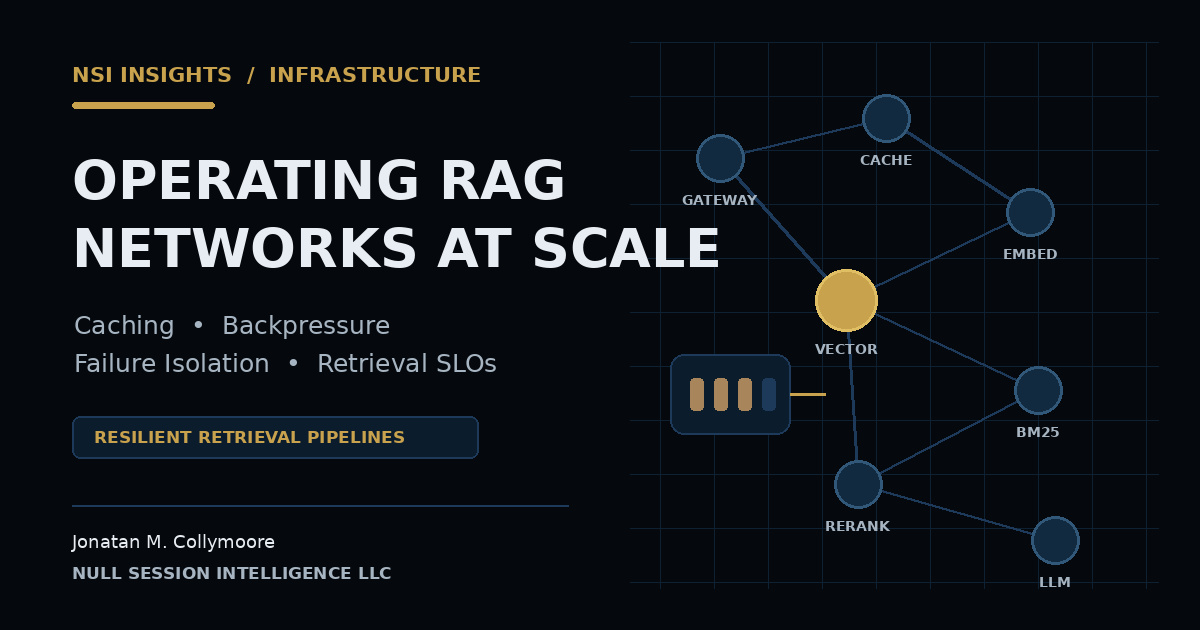
The previous guide, Network Architecture for RAG Systems, established the baseline architecture: place the vector database close to the application, keep embedding, vector search, reranking, and LLM calls on a measured critical path, pool long-lived connections, and run BM25 plus vector retrieval in parallel when the product needs both recall and precision. That architecture is enough to build a working production system. It is not enough to keep the system stable when concurrency rises, the embedding provider slows down, the vector index rebuilds, or a noisy tenant sends a thousand retrieval requests in a minute.
At scale, RAG networking stops being a placement problem and becomes a control-plane problem. The question is no longer only "Where does Qdrant, Pinecone, or Weaviate live?" The question becomes: how does the retrieval network shed load, reuse expensive embeddings, isolate failure domains, keep connection pools from stampeding, and prevent a single slow dependency from consuming every agent worker? A RAG pipeline is a chain of network hops, and the chain fails operationally when one hop has no budget, no queue, no circuit breaker, and no local fallback.
This guide is the operating manual for that next layer: cache topology, backpressure, queueing, vector database connection pooling, hybrid search fanout, reranker isolation, embedding egress optimization, and failure runbooks. It assumes the core pipeline is already in place: embed → search → rerank → LLM → response. The goal is to make that pipeline predictable under load.
The production latency budget
A healthy RAG system has an explicit latency budget before the LLM starts generating. As an illustrative starting point—not a universal standard—interactive workflows can target retrieval under 500ms at p95, with a stretch budget around 800ms when reranking or multi-index search is required. Validate these budgets with workload-specific load tests, user expectations, and product SLOs. If retrieval takes two seconds before first token, users perceive the whole AI system as slow even if the model streams quickly afterward.
# Example interactive RAG latency budget, p95
query validation/authz        10-25ms
embedding service             50-180ms  # SaaS; 15-60ms self-hosted GPU
vector search                 20-120ms  # depends on filters, shard count, index size
BM25 search                   15-80ms   # parallel branch, not additive if fused correctly
result merge/fusion            5-25ms
reranker                      60-220ms  # optional but often critical for precision
context assembly              10-40ms
---------------------------------------
retrieval before LLM         170-690ms
The numbers matter because network architecture decisions change which stages are sequential and which can be parallel. Embedding is usually sequential: the system cannot search a vector index until it has a query vector. BM25 can run in parallel with embedding if it only needs the raw query text. Reranking is sequential after candidate retrieval, but it can be isolated to a smaller candidate set. LLM generation is downstream of everything unless the application streams a partial answer before retrieval completes, which is risky for factual workflows.
The fastest RAG network is not the network with the fewest services. It is the one where every service has a measured budget, every expensive call is reused, and every slow dependency is prevented from capturing the worker pool.
Topology: where each RAG service should live
The recommended topology separates the RAG stack into five network zones: ingress, agent runtime, retrieval data, inference, and egress. The boundaries are important because retrieval systems handle sensitive documents and because embedding APIs often transmit raw text to external providers.
Internet / users
  → ingress gateway / WAF
  → agent runtime zone
      → embedding gateway / cache
      → vector DB zone (Qdrant / Weaviate / Pinecone private endpoint)
      → keyword search zone (OpenSearch / Elasticsearch / Postgres FTS)
      → reranker service zone
      → LLM gateway
  → response stream
Self-hosted Qdrant or Weaviate should sit in the retrieval data zone, reachable only from agent runtimes, indexer jobs, and observability probes. In Kubernetes, this normally means a dedicated namespace with default-deny NetworkPolicies and explicit ingress on Qdrant's HTTP and gRPC ports. For high-throughput clusters, keep the application and vector nodes in the same region and preferably the same availability zone unless the business availability requirement justifies cross-AZ latency. A 2-5ms cross-AZ penalty sounds small until it applies to every search, every scroll, every shard fanout, and every retry.
Pinecone and Weaviate Cloud should be reached through private connectivity when available: PrivateLink, VPC peering, or a provider-supported private endpoint. If public internet access is the only option, route traffic through a controlled NAT gateway or egress proxy with allowlisted destinations and separate connection tracking from general application egress. Do not let document retrieval traffic share the same undifferentiated outbound path as package downloads, browser automation, and arbitrary agent tools.
BM25 or sparse search should not be an afterthought. If keyword search runs in OpenSearch or Elasticsearch, place it close to the vector database and the app runtime. Hybrid retrieval often doubles the number of backend calls per user query, but it should not double latency if the branches run concurrently and fuse results after both return.
Connection pooling between agent runtimes and vector databases
Agent runtimes are bursty. A single user task may trigger one retrieval call, while an autonomous workflow may trigger dozens of tool calls, memory lookups, and follow-up retrievals. Without pooling, every retrieval pays TCP setup, TLS negotiation, authentication, and connection warmup. With aggressive pooling but no limits, a burst of agents can open hundreds of streams to the vector database and make the database look unhealthy even when CPU and disk are fine.
A practical starting point for a self-hosted Qdrant deployment is one shared client per runtime process, HTTP/2 or gRPC keepalive enabled, and a pool sized by concurrency rather than by CPU count:
# Illustrative pseudoconfiguration — tune with load tests
max_vector_connections = min(concurrent_agent_workers * 2, 100)
max_inflight_searches_per_worker = 4
connect_timeout_ms = 300
read_timeout_ms = 900
keepalive_time_s = 30
keepalive_timeout_s = 10
retry_budget = 1 retry only for idempotent reads
For Pinecone and other SaaS vector databases, the SDK may hide the pool, but the network behavior still exists. Inspect connection reuse at the egress proxy or NAT gateway. If every query creates a new outbound TCP connection, the SDK is misconfigured, the process lifecycle is too short, or the application is instantiating clients per request. In serverless agent runtimes, cold starts can make this unavoidable; compensate by batching retrievals, using warm workers for high-volume tenants, or adding a retrieval gateway service that keeps persistent upstream connections.
Embedding service egress optimization
Embedding calls are the most common source of preventable egress cost and preventable latency. Query-time embedding is usually small, but indexing-time embedding can transmit millions of chunks. If each chunk is sent as an individual HTTPS request, the network cost is dominated by request overhead and connection churn rather than payload bytes.
Use three controls:
- Batching: group 20-100 chunks per embedding API call where provider limits allow. This reduces per-chunk request overhead and makes NAT connection tracking easier to predict.
- Embedding cache: key by
model_id + normalized_text_hash + chunking_version. Store query embeddings for short TTLs (5-30 minutes) and document embeddings indefinitely until the document or model version changes. - Egress separation: route embedding provider traffic through a dedicated NAT gateway or egress proxy with its own rate limits, metrics, and alerts.
# Illustrative pseudocode — adapt to your implementation
sha256(
  model_id + "\n" +
  chunking_policy_version + "\n" +
  normalized_text
)

# Cache policy
query_embedding_ttl: 15m
document_embedding_ttl: until document_version or model_version changes
negative_cache_for_provider_429: 30-120s jittered
Do not ignore region selection. A 70ms RTT to an embedding provider is paid before vector search can begin. If you use OpenAI, Cohere, Voyage, or another SaaS embedding provider, measure RTT from the application subnet, not from your laptop. If you self-host embeddings, put the embedding service near the agent runtime and size GPU batching so that network time does not disappear only to be replaced by queue time.
Hybrid search networking: parallel, bounded, and fused
Hybrid search improves recall by combining sparse lexical matching with dense vector similarity. The network trap is running BM25 after vector search, or vector search after BM25, simply because the application code was written sequentially. In most systems, BM25 can start immediately with the raw query while the embedding request is in flight. Vector search starts as soon as the embedding returns. The two branches then meet at a fusion stage.
t=0ms    start BM25(query text)
t=0ms    start embed(query text)
t=90ms   embedding returns
t=91ms   start vector search(query vector)
t=130ms  BM25 returns
t=170ms  vector search returns
t=175ms  reciprocal-rank fusion
t=180ms  reranker top 40 → top 8
t=330ms  send context to LLM
The fanout must be bounded. Set independent timeouts for each branch and fuse partial results when a non-critical branch misses its budget. For example, if BM25 is used as a recall booster, a vector-only answer may be acceptable when OpenSearch is degraded. If vector search is the primary retrieval path for semantic questions, BM25-only fallback should be clearly marked or limited to workflows where keyword evidence is sufficient.
Backpressure and queueing
The failure mode that takes down RAG systems is not always an outage. More often it is a slow dependency that causes request accumulation. Agent workers wait on embedding. Connection pools fill. Retries multiply traffic. The vector database sees duplicate searches. The reranker queue grows. Eventually the LLM receives fewer requests, but the application is already saturated.
Backpressure must exist at every expensive boundary:
- Before embedding: per-tenant query concurrency limits and token-bucket rate limits.
- Before vector search: maximum in-flight searches per runtime and per collection.
- Before reranking: queue depth limits and candidate caps.
- Before LLM generation: retrieval timeout enforcement so slow retrieval does not consume model slots indefinitely.
# Illustrative pseudoconfiguration — not universal defaults
tenant_default_qps: 5
premium_tenant_qps: 25
max_inflight_embeddings_per_tenant: 20
max_inflight_vector_searches_per_collection: 100
reranker_queue_max_depth: 500
retrieval_deadline_ms: 800
serve_partial_if_bm25_missing: true
serve_partial_if_vector_missing: false
Retries need budgets. Retrying every failed hop once can double traffic during an outage. Use a single retry only for idempotent reads, with jitter, and never retry after the overall retrieval deadline has less than 150ms remaining. When the provider returns 429, treat it as a backpressure signal, not a mystery error. Cache the negative signal briefly and slow down callers.
Failure isolation patterns
A production RAG network should degrade deliberately. The retrieval gateway or agent runtime needs a decision table for each dependency:
Dependency          Failure mode        Response
embedding API       429 / timeout       use cached query embedding if present; otherwise fail fast
vector DB           timeout             try read replica once; otherwise no-answer with explanation
BM25 search         timeout             continue vector-only if confidence threshold met
reranker            saturated           skip rerank; use RRF/top-k with lower confidence
LLM provider        timeout             preserve retrieval trace; retry answer generation only
Vector database read replicas should be isolated from indexing pressure. If ingestion jobs share the same nodes and network path as query traffic, bulk embedding and upsert operations can degrade user-facing search. Use separate worker pools, separate API keys, and, where possible, separate network policies for indexing vs. query workloads. In Qdrant, separate collections or shard replicas can help isolate tenants; in Pinecone, consider separate indexes for noisy workloads when namespace-level isolation is insufficient.
Observability for the retrieval network
Log the retrieval trace for every request. The trace should include timings for embedding, vector search, BM25, fusion, rerank, context assembly, and LLM time-to-first-token. Aggregate p50, p95, and p99 by tenant, collection, model, region, and provider.
{
  "request_id": "rag_01J...",
  "tenant": "acme",
  "embedding_ms": 94,
  "vector_search_ms": 48,
  "bm25_ms": 31,
  "fusion_ms": 6,
  "rerank_ms": 126,
  "context_tokens": 6420,
  "retrieval_total_ms": 323,
  "vector_pool_wait_ms": 4,
  "egress_region": "us-east-1",
  "fallbacks": []
}
The most useful alert is not "RAG is slow." Alert on leading indicators. Illustrative starting thresholds include connection pool wait time above 50ms, embedding 429 rate above 1%, reranker queue depth above 70% of its configured limit, vector search p95 above its budget for five minutes, and retrieval timeout rate above 2%. These are examples—not universal defaults—and should be calibrated to observed baselines, error budgets, and workload-specific SLOs.
Operational runbook
When retrieval latency spikes, follow a fixed order. First, split the problem by hop. If embedding time is high, inspect provider status, egress RTT, NAT connection tracking, and client reuse. If vector search is high, check collection-specific QPS, shard health, filter selectivity, payload size, and pool wait time. If reranking is high, check queue depth and candidate count. If the LLM starts late but retrieval looks normal, inspect context assembly and token payload size.
# Triage checklist
1. Compare retrieval_total_ms vs LLM time-to-first-token.
2. Break retrieval into embed/search/BM25/rerank/context timings.
3. Check pool_wait_ms before blaming the database.
4. Check NAT/egress connection counts before blaming SaaS providers.
5. Disable optional rerank for one tenant or one route, not globally.
6. Reduce top_k and candidate fanout before adding replicas.
7. Confirm indexer jobs are not sharing the query path.
8. Restore normal limits only after p95 is stable for 15 minutes.
Reference architecture
A resilient RAG network at moderate scale can use this baseline:
- Agent runtime in private subnets with one shared retrieval client per process.
- Dedicated retrieval gateway that owns deadlines, pooling, rate limits, fusion, and fallback decisions.
- Self-hosted Qdrant or Weaviate in a data namespace with default-deny ingress and separate query/indexer credentials, or SaaS vector DB through private connectivity.
- OpenSearch or Elasticsearch for BM25 in the same region as the vector database.
- Embedding gateway with cache, batching, provider-specific egress policy, and explicit 429 handling.
- Reranker service isolated behind its own queue and timeout so it cannot starve retrieval.
- Structured retrieval traces exported to OpenTelemetry and dashboards grouped by tenant, collection, provider, and model.
The architecture is not vendor-specific. Qdrant, Pinecone, and Weaviate differ in deployment model, indexing behavior, and SDK details, but the network rules are the same: colocate critical sequential hops, pool long-lived connections, run independent retrieval branches in parallel, bound fanout, cache expensive transformations, and isolate failure before retries amplify it.
Official references
- Qdrant API and SDK interfaces — REST and gRPC connectivity.
- Qdrant distributed deployment — sharding, replication, and cluster operations.
- Pinecone private endpoints — AWS PrivateLink and Azure Private Link.
- Weaviate production deployment — production configuration and operational guidance.
- Kubernetes NetworkPolicy — traffic controls for isolated service zones.
- OpenTelemetry semantic conventions — standardized telemetry attributes.
Frequently asked questions
What is the target latency budget for production RAG retrieval?
For interactive RAG systems, retrieval before LLM generation can use 500ms at p95 as an illustrative starting target, with a stretch budget around 800ms when reranking or multi-index hybrid search is required. Track embedding, vector search, BM25, rerank, and context assembly separately, then calibrate the final budget to workload-specific SLOs.
How should vector database connection pools be sized?
Start with one shared client per runtime process, long-lived HTTP/2 or gRPC connections, and a bounded pool based on measured concurrency. Tune using pool wait time, p95 vector search latency, load tests, and database-side connection metrics rather than CPU count alone.
How can embedding API egress be reduced?
Batch document chunks, cache embeddings by model, chunking policy, and normalized text hash, use short TTLs for repeated query embeddings, and route provider traffic through a dedicated egress gateway with rate limits and observability. Bulk indexing should not share unconstrained egress with user-facing query traffic.
How should hybrid BM25 and vector search be networked?
Run BM25 and embedding/vector branches in parallel whenever possible, then fuse results with reciprocal rank fusion or a similar strategy. Give each branch its own timeout and fuse partial results only when the product can tolerate degraded recall or precision.
Conclusion
RAG systems fail at scale when their network assumptions remain implicit. A prototype can survive with a vector database endpoint, an embedding API key, and a few sequential function calls. A production system needs deadlines, pools, caches, queues, and fallbacks. The network architecture is the reliability architecture.
For teams building agentic RAG systems, the next maturity step is to treat retrieval as a first-class platform component. Put a gateway in front of it. Give it budgets. Trace every hop. Separate query traffic from indexing traffic. Keep embedding egress visible. Make hybrid search parallel. Most importantly, decide how the system degrades before the first incident forces the decision for you.
Need resilient AI infrastructure?
Null Session Intelligence designs secure, measurable AI and retrieval systems for production environments.
Discuss your architecture