How to Outsource IT Without Losing Security, Visibility, or Institutional Knowledge

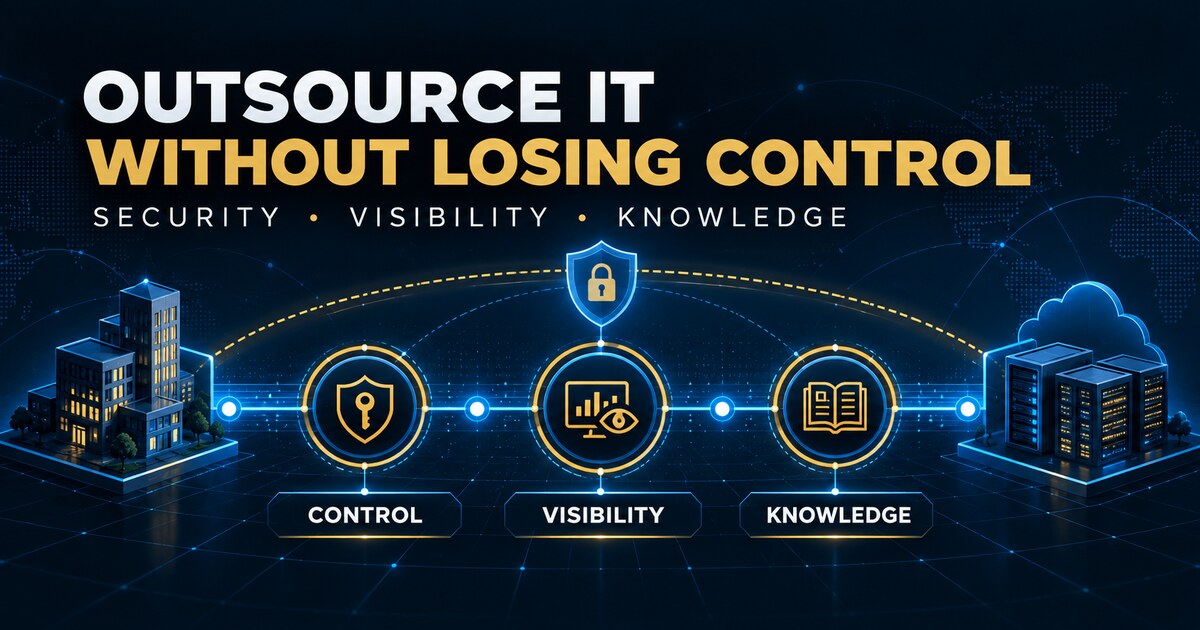
Outsourcing IT is often presented as a simple financial decision: compare the internal payroll with a provider’s monthly fee and sign. That model is incomplete. The real question is whether the organization can obtain better operational coverage without giving away the ability to understand, challenge, and recover its own technology.
Outsource execution when it improves the service. Never outsource ownership of risk, architecture, evidence, or critical decisions.
What is changing
Managed service providers now operate cloud platforms, endpoints, identity systems, security monitoring, software delivery, and AI-enabled workflows. That concentration can be valuable: a provider may have 24/7 coverage, specialized skills, and repeatable runbooks that a mid-sized team cannot economically maintain.
It also creates a sharper dependency. A provider with privileged access, undocumented automation, and opaque subcontractors can become a single point of failure. AI makes the boundary more important: automated tickets, copilots, and response agents can act quickly, but speed without traceability turns a service relationship into an unreviewable control plane.
Why leaders should care
- Security: outsourced administrators and support tools expand the identity and supply-chain attack surface.
- Visibility: dashboards can show green status while hiding exceptions, delayed patches, or missing evidence.
- Continuity: a provider outage, contract dispute, acquisition, or staff turnover can interrupt access to critical knowledge.
- Economics: a low monthly price can conceal transition work, egress costs, change fees, and lock-in.
The technical reality beneath the contract
Access is a design decision
Do not give a provider a permanent super-admin account because it is convenient. Use named identities, phishing-resistant MFA for privileged roles, just-in-time elevation where available, separate break-glass procedures, and logs that your organization—not only the provider—can retrieve. Provider access should be scoped to resources, actions, time, and an accountable owner.
principal: named-provider-identity
resource: production-database
action: read-metadata | change-config | restore-backup
context: approved-ticket + MFA + managed-device
expiry: explicit timestamp
evidence: request + approval + result + timestamp
Evidence must cross the boundary
A provider’s statement that a control is active is not the same as evidence that your environment received the control. Require machine-readable logs, vulnerability and patch reports, access-review records, backup results, incident timelines, and a clear retention period. Evidence should be delivered to a system your team controls or can export without negotiation.
AI changes operations, not accountability
Providers may use AI to classify alerts, summarize tickets, generate scripts, or recommend remediation. Ask where prompts, logs, customer data, and generated code go. Define which actions require human approval. A provider should be able to explain the model-assisted step, the source evidence, the reviewer, and the rollback path.
A practical outsourcing decision framework
Score a candidate capability across five dimensions before discussing price:
- Criticality: what happens if the service is unavailable or wrong for 24 hours?
- Privilege: can the provider change identity, production, backups, money, or regulated data?
- Observability: can your team independently verify performance, access, and security?
- Replaceability: can another provider or an internal team take over with the available documentation?
- Learning value: does the arrangement build internal understanding or quietly remove it?
A capability with high criticality and high privilege should not be outsourced as a black box. It may still be operated by a provider, but the organization needs internal ownership, independent evidence, tested recovery, and an exit plan.
What the operating model should contain
1. A retained internal owner
Keep an internal person accountable for the service, risk acceptance, architecture decisions, and escalation. This is not redundant with a provider account manager; it is the organization’s technical memory and decision authority.
2. A control plane you can inspect
Maintain the authoritative inventory, identity groups, network diagrams, data classifications, backup locations, integrations, and monitoring destinations. If the provider uses its own tooling, require exports and documented mappings.
3. Contractual security outcomes
Specify privileged-access reviews, patch windows by severity, incident notification time, log delivery, backup restoration tests, vulnerability remediation ownership, subcontractor disclosure, data deletion, and cooperation with investigations. “Industry standard security” is not a measurable outcome.
4. A rehearsed exit
Request an exit runbook before signing. It should cover credentials, certificates, DNS, code, configurations, data exports, licenses, contacts, open incidents, and knowledge-transfer sessions. Test a limited handover annually; an exit plan that has never been exercised is an assumption.
Common failure patterns
- Lowest-price selection: the cheapest proposal often excludes transition, after-hours response, or evidence.
- Shared accounts: they make attribution and offboarding weak.
- Provider-owned logs: they delay investigations and make disputes harder to resolve.
- Permanent exceptions: temporary access becomes an invisible standing privilege.
- Knowledge as a side effect: documentation is postponed until the relationship is already ending.
A 90-day implementation sequence
- Days 1–20 — map dependency: inventory services, owners, provider identities, privileged paths, data flows, subcontractors, and renewal dates.
- Days 21–45 — close control gaps: remove shared access, centralize evidence, define incident paths, and fix missing ownership.
- Days 46–70 — test reality: sample access logs, validate patch and backup claims, run a recovery exercise, and interview the internal owner.
- Days 71–90 — make it durable: approve scorecards, rehearse a partial exit, document exceptions with expiration, and renegotiate measurable outcomes.
What happens next
The strongest outsourcing relationships will look less like “handing over IT” and more like an accountable operating partnership. Providers will supply scale and specialized execution. Customers will retain the architecture, evidence, risk decisions, and institutional memory that make technology an asset rather than an external dependency.
Frequently asked questions
When should a company outsource IT?
Outsource when a provider can deliver a repeatable capability with stronger coverage or economics, while the company retains ownership of risk, architecture, and decisions.
Does outsourcing reduce security responsibility?
No. A provider can operate controls, but the company remains responsible for scope, access, data handling, evidence, incident decisions, and oversight.
How do we prevent loss of institutional knowledge?
Keep an internal service owner, maintain current architecture and runbooks, require documented decisions, and test provider exit procedures before they are urgent.
What should an IT outsourcing contract measure?
Measure outcomes such as recovery performance, patch and vulnerability windows, privileged access reviews, evidence delivery, service levels, and exit readiness.