The Real Cost of Cheap Electronics: Security Updates, Repairability, Data Collection, and Product Lifespan

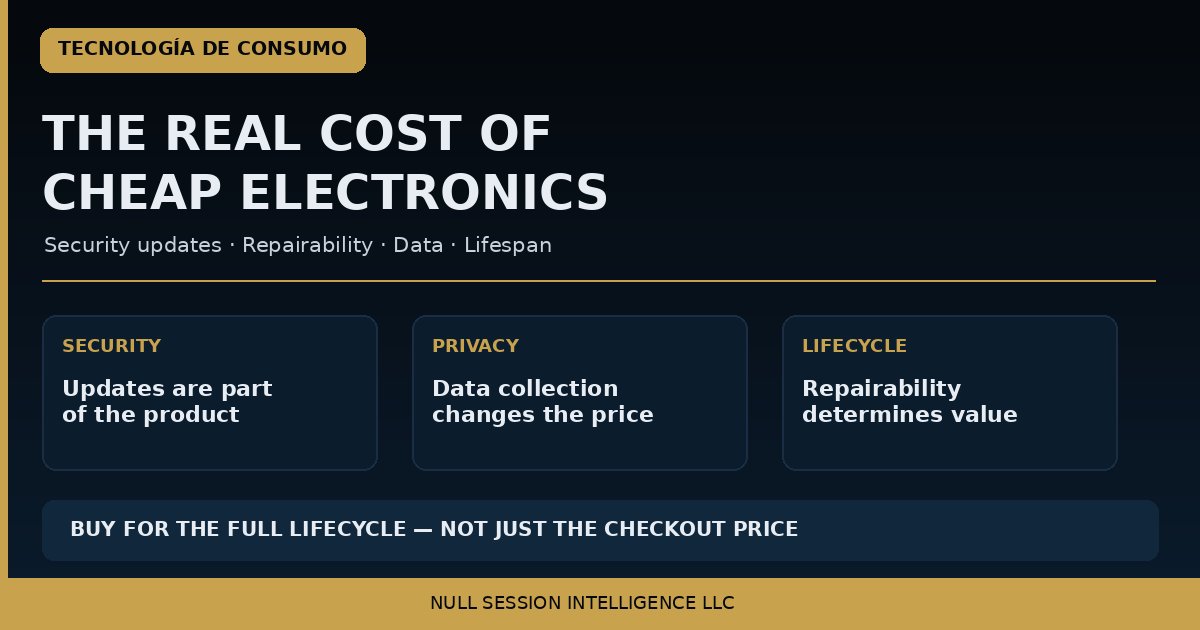
Cheap electronics are rarely cheap in the fullest sense. The price on the box is only the first line of a broader contract: how many years of patches it will receive, what data it needs to function, whether it can be repaired, and what happens when the manufacturer abandons the model.
The purchase price is a number. The cost of trust is a decision.
What Is Changing
Connected devices are gaining more sensors, mobile apps, and edge intelligence. A television, camera, watch, or router is no longer just hardware: it is an account, a remote service, an update chain, and a data stream. That dependency may add convenience, but it also makes vendor support part of the product’s security.
Pressure to lower prices accelerates product cycles. When margins depend on selling the next model or monetizing telemetry, buyers may finance the difference through advertising, usage profiles, premature replacement, or exposure to unpatched vulnerabilities.
The Total Cost Has Five Layers
1. Security and Support
A device without updates does not become unsafe overnight; it becomes harder to defend with every known vulnerability left open. Before buying, look for a public policy with an end-of-support date, a patch history, and a signed update mechanism. “Works with the app” does not mean “securely maintained.”
2. Data and Cloud Dependency
The question is not only whether the product collects data, but which functions stop working if the internet connection or account disappears. Review audio, video, location, identifiers, diagnostics, and inferred data. An inference—such as habits or presence at home—may be more sensitive than the original data.
3. Repairability
A sealed battery, proprietary adhesives, nonstandard screws, or manufacturer-only parts reduce real service life. Repairability does not mean everything must be fixable at home; it means there is a reasonable, documented, and economically sensible path to extending the product’s life.
4. Interoperability
Open standards and data exports reduce lock-in risk. In smart homes, Matter can improve interoperability, but it does not replace a review of updates, permissions, cloud dependencies, and account controls. A connectivity standard does not automatically make a vendor trustworthy.
5. Energy, Replacement, and Waste
Continuous power use, a degraded battery, or full replacement after a minor failure changes the equation. The most sustainable option is usually the one that remains secure and functional for longer, not necessarily the one that uses fewer materials on the day it is manufactured.
A Practical Buying Framework
Score each criterion from 0 to 2, and do not buy if either Security or Support scores zero:
Criterion                0                 1                 2
Support                  Not published     < 3 years         Clear, substantial term
Privacy                  Opaque data use   Basic controls     Minimization and export
Repairability            No parts          Limited service    Parts and manuals
Interoperability         Closed ecosystem  Adapters           Standards and migration
Local security           Required account  Partial            Local functions and MFA
For an organization, add two controls: an inventory of models and retirement dates, plus a data-erasure test before resale or disposal. For a consumer, create a support-expiration reminder and enable MFA on the associated account.
The Technical Reality Behind the “Smart” Label
Risk exists across the full chain: firmware, bootloader, mobile app, API, identity, cloud provider, and household permissions. A failure in any layer can expose a device that appeared isolated. In an authorized assessment, the useful question is not “does it have a camera?” but “which identity can access it, from where, with what audit trail, and for how long?”
Edge AI can reduce the transmission of audio or video, but it must be verified: is processing truly local or merely a first stage? What telemetry leaves the device? Can it be disabled? Are logs available? What happens after support ends? Declared architecture and observable behavior do not always match.
What Technology Leaders Must Decide
- Buy for the lifecycle: include support, replacement parts, migration, and retirement in the budget.
- Segment networks: place consumer devices on an IoT VLAN or SSID without unnecessary access to critical systems.
- Require evidence: a patch policy, an SBOM when applicable, an incident contact, and data-erasure documentation.
- Measure dependency: identify which functions disappear if the provider changes prices, APIs, or terms.
Checklist Before You Pay
- Is the end-of-support date visible?
- Does the account support MFA and separate roles?
- Does the device retain useful functions without the cloud?
- Can I export my data and delete the account?
- Are batteries, parts, and repair services available?
- Can I isolate it from laptops, servers, and critical cameras?
- Does the savings justify premature replacement?
What Comes Next
The next competitive advantage in electronics will not be adding another generative feature to the box. It will be proving a secure service life: predictable updates, verifiable local processing, accessible repair, and migration when the provider ceases to exist. Buyers will learn to treat support as a specification; companies that cannot prove it will lose trust even if their products are inexpensive.
Frequently Asked Questions
- Does a low price always mean a bad purchase? — Not necessarily; total cost and support matter.
- What security support should I require? — A published end date, signed updates, and a credible update process.
- How can I compare privacy? — Review collection, processing, retention, controls, and account dependency.
- What is repairability? — A documented, affordable path to parts, manuals, and repair.
Need to turn this analysis into a safer decision?
At NSI, we connect security, infrastructure, and strategy to build practical solutions.
CONTACT NSI