
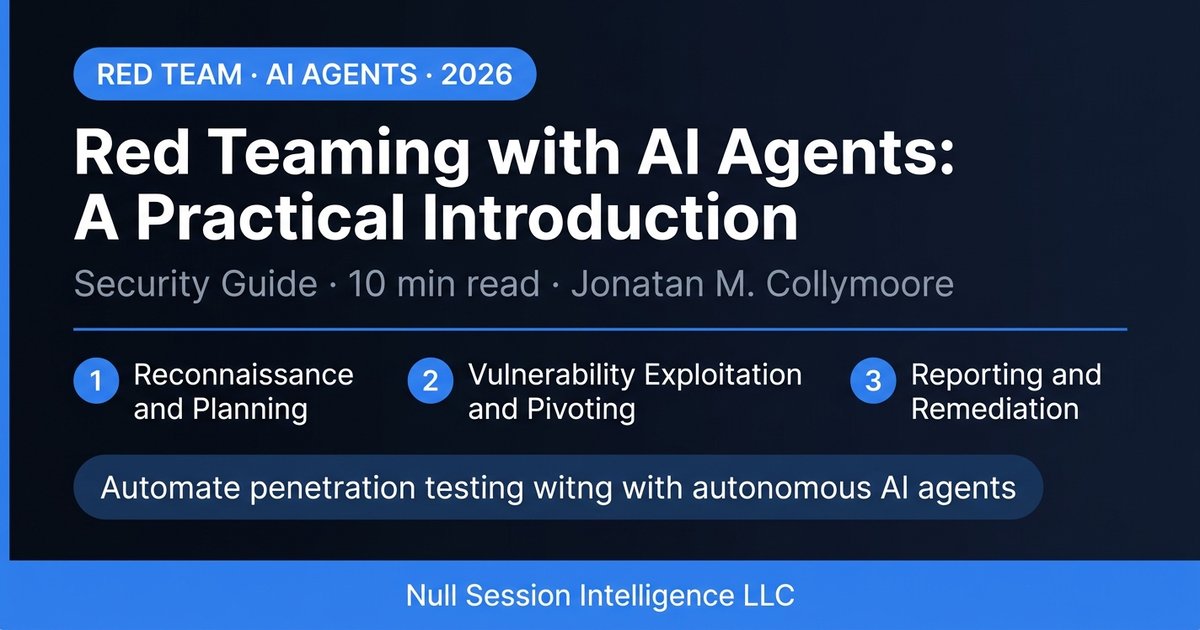
Red teaming has traditionally been a manual, labor-intensive discipline. A team of security experts spends weeks planning, executing, and documenting simulated attacks. The results are valuable, but the process is slow and expensive.
AI agents are changing that. Not by replacing human red teamers, but by augmenting them with autonomous capabilities that operate at machine speed. This article is a practical introduction to how AI agents fit into red team operations.
What Is AI-Augmented Red Teaming?
AI-augmented red teaming uses large language models (LLMs) as a reasoning engine to drive autonomous agents during security assessments. These agents can:
- Reconnoiter targets across networks, applications, and people
- Identify vulnerabilities through automated scanning and logic analysis
- Chain exploits to simulate multi-stage attack scenarios
- Document findings with evidence and remediation steps
The key difference from traditional automation is adaptability. A script follows a fixed path; an AI agent adapts its approach based on what it discovers.
Architecture of a Red Team Agent
A red team agent typically uses a multi-agent architecture with three layers:
1. Reconnaissance Agent
This agent maps the attack surface. It queries DNS records, scans open ports, identifies technologies in use, searches for exposed credentials in public breach databases, and maps the organizational structure from LinkedIn and corporate websites. Tools like Nmap, Shodan, Censys, and theHarvester are integrated as callable functions.
2. Exploitation Agent
Once a vulnerability is identified, the exploitation agent attempts to verify it. It selects the appropriate exploit (from a curated library or generated on the fly), executes it in a sandboxed environment, and reports whether the attempt succeeded. Crucially, the agent documents every step with screenshots and logs for the final report.
3. Pivoting Agent
After gaining a foothold, the pivoting agent explores lateral movement opportunities. It examines accessible systems, checks for credential reuse, and identifies privilege escalation paths. This agent is where AI truly shines — it can correlate information across systems in ways that hardcoded scripts cannot.
Practical Workflow
A typical AI-augmented red team engagement follows this workflow:
- Scoping: The human defines the target scope, rules of engagement, and boundaries, then encodes them outside the prompt in deterministic controls: target allowlists, CIDR/domain validators, tool wrappers, egress policy, scoped credentials, and human approval gates. The prompt should repeat the rules, but the runtime must enforce them.
- Automated Reconnaissance: The reconnaissance agent runs 24/7 across the defined scope. It produces a prioritized list of findings.
- Human Review: The human red teamer reviews findings, selects high-value targets, and adjusts priorities.
- Guided Exploitation: The exploitation agent attempts to verify selected findings. The human monitors progress and intervenes when necessary.
- Reporting: Both agents contribute to a unified report with evidence, timestamps, and remediation recommendations.
Tools and Stack
Building a red team agent requires:
- Python 3.11+ — Core language with rich security tooling ecosystem
- LangGraph or CrewAI — Agent orchestration framework
- LLM (GPT-4, Claude, or open-weight models) — Reasoning engine
- Metasploit, Nmap, Burp Suite — Traditional tools wrapped as agent functions
- Hardened isolation — Dedicated lab VM or hardened container runtime for exploit tooling; if Docker is used, follow Docker's security guidance: non-root user, no
--privileged, no host mounts, restricted capabilities, seccomp/AppArmor/SELinux profiles, isolated network, and disposable snapshots
Risks and Guardrails
AI red teaming introduces specific risks that must be managed:
- Scope creep: An autonomous agent may explore beyond authorized boundaries. Use defense in depth: system-prompt instructions plus deterministic allowlists, parser validation, tool-level deny rules, scoped credentials, egress filtering, and human approval for active testing. OWASP's prompt injection guidance treats least privilege, validation, monitoring, and human-in-the-loop controls as separate layers.
- False positives: AI may hallucinate vulnerabilities that do not exist. Every finding must be verifiable and reproducible.
- Logging: Every action must be logged with timestamps and evidence. An undocumentable action is unacceptable.
- Human oversight: No autonomous decision should be irreversible without human approval. Destructive actions require explicit confirmation.
The best red team agent is not the one that finds the most vulnerabilities, but the one that documents every finding with enough clarity that a human can act on it immediately.
Frequently asked questions
What is AI red teaming?
AI red teaming uses autonomous agents to simulate adversarial behavior against systems, networks, and applications to identify vulnerabilities before real attackers can exploit them.
Do I need specialized hardware?
No. Most AI red teaming tools run on standard cloud instances. The compute requirements are modest compared to training models.
Is AI red teaming legal?
Yes, when conducted on your own systems or with explicit written authorization. Always operate under a signed scope of work.
Can AI replace human red teamers?
Not entirely. AI excels at breadth and speed, but human judgment is still critical for strategic analysis, context, and creative attack vectors.
Conclusion
AI agents are not replacing red teamers — they are force multipliers. The analyst who works with AI agents will outperform the one who works without them, not because the AI is smarter, but because it handles the breadth while the human focuses on the depth.
The future of red teaming is a partnership between human creativity and machine speed. Organizations that adopt this model will identify vulnerabilities faster, test more scenarios, and ultimately build more resilient systems.