
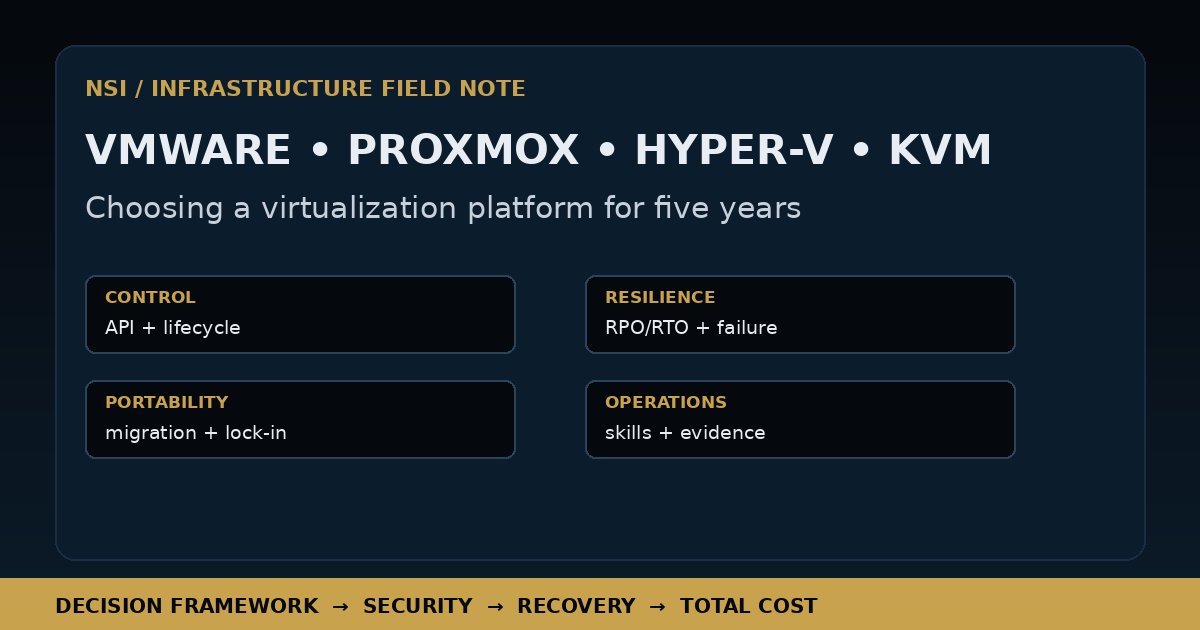
Virtualization is now the control plane for identity, workloads, backups, networks, patching, recovery, and increasingly AI services. A platform chosen during a server refresh can shape security evidence and operating leverage for half a decade.
What changed
The question is no longer only which product runs the most VMs. Licensing changes, acquisition risk, hardware cycles, cloud connectivity, ransomware recovery, and skills availability all matter. AI adds GPU scheduling, fast storage, data residency, model integrity, and strict boundaries around prompts and datasets. The virtualization layer therefore participates in data governance.
The platforms in plain terms
| Platform | Good fit | Trade-off |
|---|---|---|
| VMware vSphere | Large estates with mature enterprise operations and ecosystem depth. | Commercial dependency, licensing exposure, migration cost. |
| Proxmox VE | Teams wanting integrated KVM/LXC, local control, web/API management. | Support model, ecosystem depth, operating consistency. |
| Hyper-V | Microsoft-centered Windows and Active Directory environments. | Fit for heterogeneous estates and Microsoft-plane dependency. |
| KVM | Composable Linux foundations, OpenStack, libvirt, or Kubernetes-adjacent systems. | Integration burden: the hypervisor is only the foundation. |
These are starting positions, not rankings. A capable platform still fails when restores, role separation, or on-call procedures are untested.
Assess the privileged control plane
- Identity: MFA, carefully federated access, separate break-glass accounts, reviewed service accounts.
- Authorization: explicit rights for create, clone, migrate, storage, networks, and snapshot deletion.
- Segmentation: separate management, storage, migration, backup, and guest traffic.
- Evidence: export administrative events, changes, authentication, and backup outcomes outside the platform.
- Updates: document firmware, hypervisor, guest tools, drivers, templates, and agents.
Recovery is the architecture test
Define RPO (acceptable data loss) and RTO (acceptable outage), then test the sequence that connects them.
Recovery rehearsal
1. Validate break-glass access and isolate management.
2. Restore the control plane or documented replacement host.
3. Recover identity, DNS, storage, and network dependencies.
4. Restore one critical workload from a clean recovery point.
5. Validate application behavior, logs, and access controls.
6. Record time and gaps; fix the runbook.
Snapshots are not backups. Replication is not immutable recovery. A second cluster is not disaster recovery if it shares identity, storage, credentials, or the same failure domain.
Portability and five-year cost
Portability includes virtual hardware, drivers, network semantics, storage performance, licensing, automation, monitoring, backup format, and people. Rehearse a migration with a representative workload, not a blank VM. Keep an exit register with owner, dependencies, export format, destination, downtime, integrity check, and labor estimate.
Decision matrix
| Question | Evidence | Weight |
|---|---|---|
| Can we recover? | Observed restore, immutable copy, clean-room procedure | 30% |
| Can we secure it? | MFA/RBAC, logs, segmentation, patch SLA | 25% |
| Can we operate it? | Skills, automation, support, on-call runbook | 20% |
| Can we leave it? | Migration rehearsal, formats, exit cost | 15% |
| What does it cost? | License, hardware, labor, backup, training | 10% |
Score with evidence, not optimism. A cheap platform without tested recovery should not beat a costlier platform with demonstrated controls; an expensive platform should not receive a security premium merely for being familiar.
AI and the control plane
AI can inventory dependencies, summarize drift, compare recovery logs, and model capacity. Keep collection separate from change execution, require human approval for privileged actions, and log the source data behind recommendations. A VM does not automatically solve prompt injection, data leakage, or overprivileged automation.
Practical checklist
- Inventory workloads, dependencies, owners, RPO/RTO, and hardware constraints.
- Threat-model management identities, APIs, storage, backup, and guest-escape assumptions.
- Test two representative workloads and one failure scenario.
- Rehearse restore and platform replacement before production migration.
- Record exit paths, skills gaps, five-year cost, and reversibility.
- Approve only when security, operations, finance, and workload owners agree on evidence.
What comes next
Virtualization will become less visible to users and more important to governance. Organizations will combine VMs, containers, accelerators, and cloud capacity. The differentiator will be identity, policy, observability, recovery, and the ability to change direction without stopping the business.
Frequently asked questions
Is VMware still the best choice?
There is no universal best choice; compare licensing, recovery, skills, security controls, and exit cost.
Is Proxmox suitable for production?
It can be, if support, backup, high availability, monitoring, access control, and staff capability are validated.
When should a team choose KVM directly?
When it wants a composable Linux foundation and can operate the surrounding management and observability layers.
How should the choice be reviewed?
Review annually and after major licensing, security, hardware, cloud, or recovery changes. Re-test restoration.
Need help making this decision?
NSI helps teams turn infrastructure choices into secure, testable operating systems.
CONTACT NSI