API Security Testing in Practice: Authorization, Business Logic, and Abuse-Case Validation

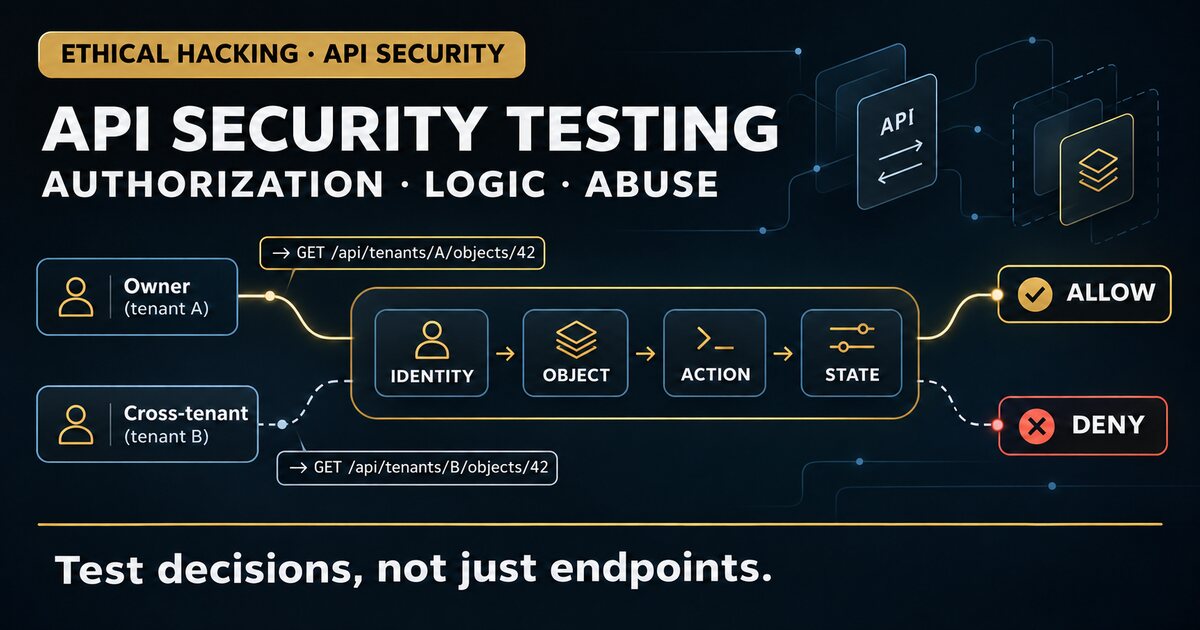
Endpoint coverage is not authorization coverage
API security testing is often reduced to a list of routes and status codes. That misses the real question: whether each identity can perform each action on each object under every relevant business state. An endpoint may be documented, authenticated, and still expose another customer’s invoice, execute an administrative function, or accept a replayed transition.
For an authorized assessment, start with a small set of synthetic accounts and objects. Map the trust boundaries before increasing coverage. The objective is not to collect data; it is to prove whether the server enforces ownership, role, tenant, and state constraints. This follows the distinction made by the OWASP API Security Top 10, where object-, property-, and function-level authorization are separate failure modes.
The security boundary is the authorization decision at the moment of action—not the URL, the frontend, or the API documentation.
A practical test model
1. Build an identity and object matrix
Create at least an owner, a peer user, a lower-privilege user, and—where applicable—a second tenant. Mark which objects each account owns and which functions each role should access. Use designated test records, never unrelated customer data.
Actor A: tenant-1 / member / owns order-101
Actor B: tenant-1 / member / owns order-202
Actor C: tenant-2 / admin  / owns order-303

Expected: A→101, B→202, C→303 only
Probe: read, update, delete, export, approve
2. Test BOLA across methods and representations
Broken Object Level Authorization (BOLA) appears when changing an identifier gives access to an object the caller does not own. Test the same object reference in path parameters, query strings, JSON bodies, nested resources, batch requests, and alternate API versions. Compare a denied response with an authorized response without harvesting records.
3. Test function-level authorization
Do not stop at role labels in the interface. Replay a legitimate request with a lower-privilege session and compare server-side behavior for administrative actions, exports, bulk operations, approvals, and configuration changes. A hidden button is not an access control.
Business logic needs stateful testing
Many serious API flaws are valid requests used in the wrong sequence. Model states such as draft → submitted → approved → paid, then ask whether a caller can skip a control, repeat a one-time action, act after cancellation, or change a protected field between validation and execution.
- Replay: repeat idempotent-looking actions and verify whether credits, refunds, invitations, or entitlements multiply.
- Race conditions: use a narrow, approved concurrency test against synthetic records only.
- Mass assignment: add server-managed fields to a test payload and verify they are ignored or rejected.
- Abuse controls: measure rate limits, pagination ceilings, batch sizes, and expensive filters without stressing production.
Evidence that developers can act on
A defensible finding includes the account, object, precondition, minimal request delta, expected result, observed result, and a redacted response. Record timestamps and correlation IDs. One synthetic object is usually enough to establish impact. Explain the blast radius as a condition—such as “any authenticated member who knows an object identifier”—rather than claiming a breach you did not perform.
Decision framework for leaders
Executives should ask four questions: Which objects are most sensitive? Which authorization decisions are centralized? How are tenant boundaries tested in CI? What telemetry shows repeated denied or anomalous object access? The highest-return investment is usually an authorization model that is explicit, reusable, logged, and covered by negative tests—not another frontend restriction or a larger WAF rule set.
A low-noise runbook
- Confirm written scope, test window, accounts, rate limits, and stop conditions.
- Inventory schemas, routes, versions, webhooks, and mobile-client calls.
- Construct the identity/object/function/state matrix.
- Run read-only authorization checks first; escalate only with evidence.
- Validate business logic with synthetic records and bounded concurrency.
- Capture minimal evidence, redact tokens and PII, then retest the fix.
Use this runbook after mapping the authorized application attack surface. For discovery work, pair it with the low-noise reconnaissance pipeline rather than testing endpoints without context.
What changes next
As APIs become tool surfaces for AI agents, authorization failures will become more consequential: an agent can chain individually valid actions faster than a human and may possess broad delegated permissions. Teams should treat agent identities, tool scopes, approval gates, and action budgets as first-class API security controls. The next maturity step is not “AI security” as a separate silo; it is verifiable authorization across humans, services, and agents.
Official references
- OWASP API Security Top 10 — 2023: API-specific risks including BOLA, broken function authorization, resource consumption, and sensitive business flows.
- OWASP Web Security Testing Guide — API Testing: current coverage for authorization, authentication, rate limits, webhooks, GraphQL, and gRPC.
- NIST SP 800-228 update 1: risk-based protection controls across API development and runtime.
Frequently asked questions
What is BOLA?
BOLA is a server-side authorization failure where an authenticated caller can access an object they do not own or should not be allowed to access.
Is authentication enough for API security?
No. Authentication identifies the caller; authorization must independently decide whether that caller may perform the requested action on the requested object.
How can API testing avoid data exposure?
Use synthetic accounts and designated records, request minimal fields, stop after proving the condition, and redact tokens, personal data, and unrelated responses.
Should AI agents use normal user tokens?
Not by default. Prefer scoped agent identities, least-privilege tools, approval gates for high-impact actions, and auditable action budgets.
Turn your authorization model into a test plan
Bring your API roles, objects, and critical workflows. NSI will help scope a low-noise review and define evidence your developers can reproduce before testing begins.
PLAN AN API SECURITY REVIEW