
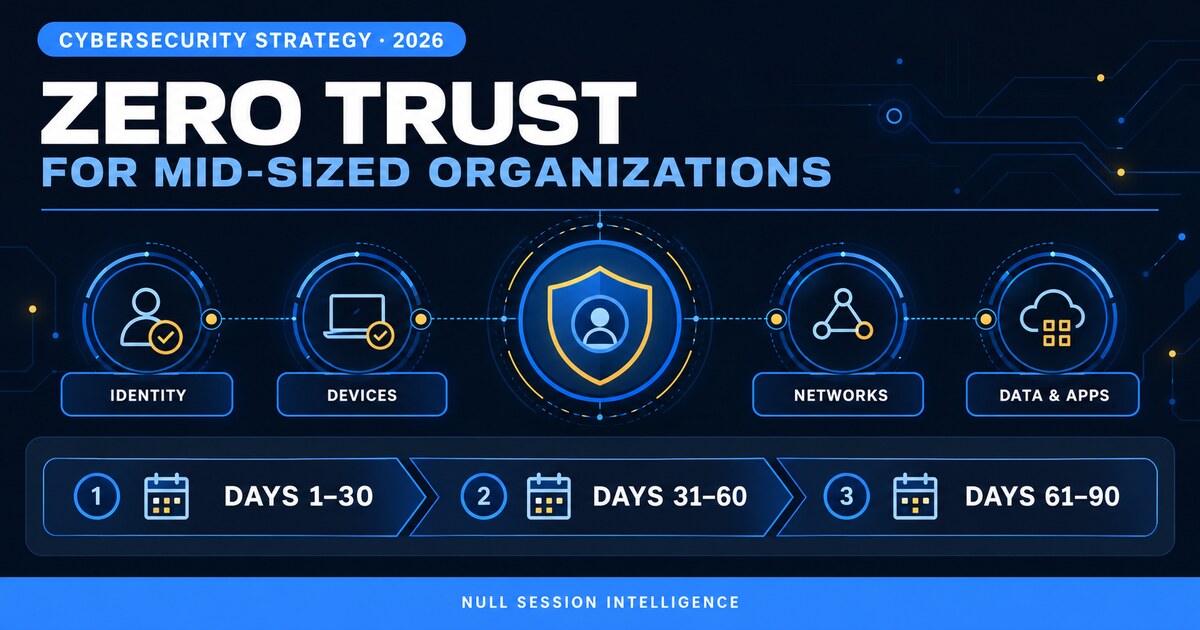
Zero Trust is no longer a slogan reserved for large enterprises. For a mid-sized organization, it is a practical way to stop treating a machine’s location, a VPN connection, or an “internal” network as proof of identity. The operating question changes from Is it inside? to Who is requesting which resource, from what device, under what conditions, and for how long?
Zero Trust is not another platform purchase. It is the discipline of replacing implicit trust with verifiable decisions.
What is changing
Mid-sized organizations rely on SaaS, hybrid work, outside suppliers, personal devices, and cloud services that share critical data. The network perimeter has blurred, yet many controls still assume that an IP address or VPN session identifies a trustworthy user.
AI increases speed on both sides. It can correlate signals and assist response, but a compromised account can also explore an environment faster. The architecture therefore needs to limit what each identity can reach and produce evidence the team can investigate—not simply more alerts.
Why act now
The goal is not to reproduce the budget or complexity of a global bank. It is to prioritize the paths where risk concentrates: email and collaboration, administrative identities, remote access, endpoints, financial applications, code repositories, and suppliers with persistent access.
- Less implicit trust: a private network does not replace authentication and resource-level authorization.
- Smaller blast radius: a stolen credential should provide little access and for a limited time.
- Better evidence: every important access decision should leave records the team can investigate.
- Realistic operations: the design must fit the organization’s staffing, budget, and maturity.
The minimum viable architecture
1. Identity as the control plane
Centralize sign-in where practical, require phishing-resistant MFA for administrators, and apply conditional access based on risk, device posture, and resource sensitivity. Separate administrative accounts from daily-use accounts. Give services their own workload identities, rotatable secrets, and specific permissions rather than sharing credentials across applications.
2. Resource-based segmentation
Segmentation is not a collection of decorative VLANs. Define which users, devices, and services may communicate—and why. A useful policy identifies the resource, identity, action, context, and expiration. An office endpoint should not directly reach databases, backup consoles, or management interfaces.
request:  user + device + workload
policy:   resource + action + context + expiry
decision: allow | step-up | deny
evidence: identity + policy + result + timestamp
3. Endpoints and workloads
Each device needs an inventory record, owner, patch state, and encryption status. Each server or container needs its own identity, a minimal attack surface, and enough telemetry to explain what happened. The objective is not theoretical perfection; it is knowing what becomes exposed when a device is lost, an account is compromised, or a supplier fails.
4. Telemetry someone can use
Record authentications, privilege changes, access to sensitive data, token creation, policy changes, and administrative actions. Define retention, time synchronization, and response ownership. A SIEM that nobody can investigate is not maturity; it is expensive storage.
NSI’s practical 90-day sequence
This sequence is an implementation framework from NSI—not a regulatory mandate. Adapt it to business risk, existing controls, and available staff.
- Days 1–15 — map trust: inventory privileged identities, critical applications, data flows, supplier access, and MFA exceptions.
- Days 16–30 — close obvious gaps: remove orphaned accounts, rotate secrets, enable strong MFA for administrators, and correct excessive privileges.
- Days 31–60 — enforce context: apply conditional access, segment high-impact resources, and make administrative sessions temporary.
- Days 61–90 — measure and rehearse: simulate a compromised account, review logs, validate recovery, and document which controls failed or created noise.
Leadership decisions and trade-offs
A Zero Trust program can fail for organizational reasons before technical ones. If every exception becomes permanent, policy loses authority. If access becomes so restrictive that teams create unofficial channels, control also disappears.
Leadership must decide which resources deserve priority, what friction is acceptable for each role, and who owns each decision. The meaningful metric is not how many rules were installed, but how much unnecessary access declined and how quickly the organization can detect and revoke a risky session.
| Decision | Fast option | Risk | Better criterion |
|---|---|---|---|
| Remote access | Broad VPN | Moves trust to the network | Access by application and role |
| MFA | SMS for everyone | Limited phishing resistance | Security keys or passkeys for critical roles |
| Monitoring | Collect everything | Noise and cost | Prioritized, actionable events |
| Exceptions | Allow indefinitely | Invisible debt | Owner, expiration, and review |
Use AI without delegating judgment
AI can classify events, summarize investigations, and propose containment paths. It should not silently decide privileges, exceptions, or whether to stop a critical process. Define tool boundaries, require human approval for high-impact actions, record prompts and outputs, and make automated decisions reproducible.
A simple control is to separate recommendation from execution. An agent may flag an anomalous session, but revocation should follow a known policy, produce an audit record, and provide a recovery path. This is also why verifiable evidence matters when auditing AI-enabled operations.
Metrics that matter
- Percentage of privileged identities using phishing-resistant MFA.
- Median time to revoke a compromised session or secret.
- Critical resources without an owner or verifiable logs.
- Supplier access with an expiration date and documented review.
- Expired exceptions without a recorded decision.
- Results from compromised-account and recovery exercises.
What comes next
Zero Trust is moving from a network project toward an operating system for access decisions. Mid-sized organizations will not succeed by buying the most products. They will succeed by connecting identity, device posture, segmentation, telemetry, and governance in a cycle their teams can actually operate.
Sources and further reading
- NIST SP 800-207: Zero Trust Architecture
- NIST SP 1800-35: Implementing a Zero Trust Architecture
- CISA Zero Trust Maturity Model
- CISA guidance on phishing-resistant MFA
Frequently asked questions
Does Zero Trust eliminate the need for a VPN?
Not always. It reduces implicit trust and can complement or replace broad tunnels with application-level access.
Does a mid-sized organization need an expensive SIEM?
It needs evidence the team can investigate. The tool should fit actual data volume, staffing, and security objectives.
Where should a Zero Trust program start?
Start with privileged identities, critical applications, phishing-resistant MFA, orphaned accounts, and supplier access.
Can AI operate Zero Trust by itself?
AI can assist analysis, but high-impact decisions still require defined policies, limits, and human accountability.